
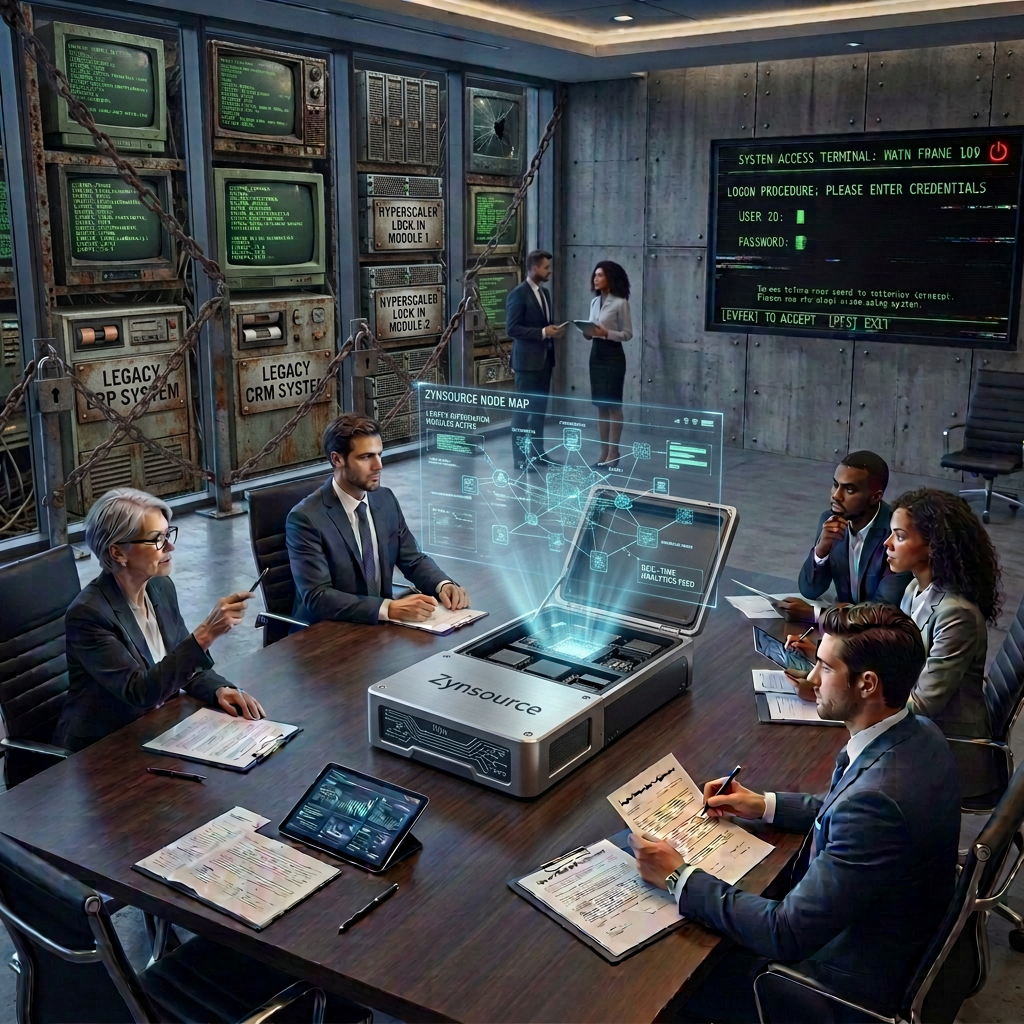
Why enterprise platforms are an information problem before they are a technology problem
Preface
Buy a car and you get to drive it before you sign. Buy an enterprise platform and you cannot evaluate it beforehand, you will not know what it really cost you for another five years, and you will not learn the price of leaving until you try to leave. Economists have a name for markets that work this way, and it is not flattering. What is striking is how much of this industry has been built on that condition rather than around it.
So the familiar arguments in enterprise technology, build or buy, open or proprietary, suite or best-of-breed, cloud or on-premise, are not really arguments about technology. They are information problems in technology clothing. Name the economics and most of them settle.
What follows is thirteen pillars. Each starts from something economists have known for decades and asks what kind of architecture it implies. The claim is deliberately not that one product beats another. It is harder than that, and easier to disprove:
If these economic premises hold, a specific architecture follows as a consequence, and any platform not built that way is optimizing for the vendor’s economics rather than the customers.
If you want to throw out the conclusion, you must throw out the premises first. That is the whole design.
The examples move around on purpose: banks, hospitals, plants, fuel distributors. None of these mechanisms belong to one industry, and a paper built entirely out of banking stories would invite the obvious complaint that it describes a local quirk. It doesn’t.
Appendix A sketches one platform built to this specification. It is there as proof that someone has done it, not as the point of the paper.
Foundation, The Economics of Ignorance
Every argument below is a special case of one idea: enterprise software is a market that runs on imperfect information, and the dominant business models depend on keeping it that way.
Textbook economics assumes buyers know what they are buying. In this market they don’t. A hospital CIO looking at a clinical data platform has no reliable way to know its maintenance burden, what leaving would cost, how much debt is accumulating inside it, or whether the code underneath is any good. That is not a failure of diligence. It is ignorance built into the situation, about a product too complicated to judge beforehand and too entangled to judge afterward.
Four results follow, and each map onto pillars below.
Information is costly to acquire (Stigler, 1961).
Knowing the real ten-year cost of an incumbent relationship, or the real maintenance tail of an in-house build, requires search effort that itself has a price. Buyers stop searching before they are fully informed — not irrationally, but because further search costs more than it is expected to return. The vendor knows the number. The buyer estimates it. That gap is the market.
Rational ignorance is real (Downs, 1957).
It is often economically sensible not to know something. This explains the most important fact about this market: executives do not price technical debt, and they are not being careless. The cost is deferred, diffuse, and typically lands on a successor. Under the incentives most technology leaders face; three-to-four-year tenures against ten-year debt horizons, remaining ignorant of it is locally rational. Pillar 2 exists to make that cost cheap enough to observe that ignoring it stops being rational.
Asymmetric information degrades markets (Akerlof, 1970).
When buyers cannot distinguish quality before purchase, they refuse to pay a premium for quality — and high-quality sellers exit or stop advertising quality. This is precisely this market’s condition, and it explains why every vendor’s claims sound identical. A buyer who cannot verify “open, portable, no lock-in” rationally discounts it to zero regardless of who says it or how true it happens to be.
This is the central commercial problem in enterprise software, and it is not a marketing problem. Saying “we don’t lock you in” more loudly does not work, because the statement carries no information. It is indistinguishable from the same sentence spoken by a vendor for whom it is false.
The escape is signaling, not assertion (Spence, 1973).
The only exit from a lemons market is a signal that would be prohibitively expensive to fake; one a low-quality competitor could not imitate even if they wished to. Not a claim, a structure. This is the entire logic of Pillar 8: permissive-only licensing, independently replaceable services, open interfaces, portable deployment. These are costly commitments that a lock-in vendor cannot copy without abandoning their own revenue model, which is what makes them informative.
Why this frames everything else
The dominant model in enterprise software is not primarily a technology strategy. It is an information strategy. Its economics require that:
• the true cost of exit remains unknown until the customer attempts to leave;
• accumulated switching cost be discovered gradually rather than disclosed up front;
• the intelligence layer stays opaque, so outputs cannot be independently benchmarked;
• the maintenance burden be experienced as an operational fact rather than a purchasing consequence.
Each is a form of preserved ignorance, and each convert into pricing power.
The alternative position, the one this paper argues follows from the economics — is a platform that competes by dissolving ignorance rather than exploiting it. Documentation makes the build knowable. Explainability makes the intelligence auditable. Verifiable openness makes the exit cost calculable before commitment rather than after. Modular services make the replacement cost of any component visible.
There is a self-serving edge to this that should be acknowledged rather than concealed: a vendor built this way wins when buyers become better informed, so of course it advocates transparency. That is not a flaw in the argument — it is the argument. It means the vendor’s incentives and the customer’s incentives point the same direction, which is what the incumbent model cannot claim about itself.
Every question this paper wants a buyer to ask is a question that reduces their ignorance: What did this actually cost to build? What debt am I accruing, and at what rate? What happens when I want to leave, and what is that priced at today? Can I inspect the model that made this decision?

The cycle is self-financing. Rent extracted at renewal pays for the conditions that produced it, which is why the pattern persists across three technology generations rather than being competed away.
Executive implication: If you cannot answer those four questions about your core platform today, you are not negotiating with your vendor; you are receiving terms from them.
Pillar 1 — Opportunity Cost: the invisible line item
Randall Bartlett’s point in Thinking Like an Economist is that the free library book isn’t free; its cost is the next-best use of the hour. The same is true of engineering capacity, and it is the line item that never appears on a build-versus-buy spreadsheet.
Take a regional health system standing up a clinical data platform. The plumbing layer, multi-tenancy, ETL, the data lake, interface engines, workflow, identity, audit, is not clinical software. It is infrastructure every health system needs, no health system competes on, and every health system pays for separately.
| Team | Duration | Fully loaded cost |
| 5 engineers | 18 months | $1,875,000 |
| 5 engineers | 24 months | $2,500,000 |
| 6 engineers | 18 months | $2,250,000 |
| 6 engineers | 24 months | $3,000,000 |
(at $250K fully loaded per engineer; burn of $104K–$125K per month)
That is the accounting cost. The economic cost is that figure plus the differentiated capability those engineers did not build during those two years, the readmission model, the capacity-planning tool, the patient-access improvement. No health system has ever won a patient because of its interface engine. No bank has ever won a depositor because of its ETL layer. No manufacturer has ever won a contract because of its historian schema.
Opportunity cost is the first casualty of imperfect information. It never appears on an invoice, has no line item, and requires the buyer to imagine a counterfactual they will never observe. Accounting systems are built to record what was spent, not what was forgone — which is why the most expensive item in the decision is structurally the one nobody can see.
The argument: infrastructure is undifferentiated by definition. Everyone needs it, nobody competes on it, and building it consumes the scarcest resource in the organization.
Executive implication: Unless the plumbing is your competitive advantage, the economics say you should buy it.
Pillar 2; Technical Debt as Deferred Cost
AI-assisted development is the purest modern illustration of a cost that has been moved rather than removed. It compresses the prototype timeline dramatically and genuinely; that gain is real and arguing against it is a losing position.
What it does not produce is architecture. A manufacturing team can now generate a working predictive-maintenance prototype against their historian in days rather than months. What they have generated is working code without type safety, without documented interfaces, without test coverage, without drift control, and without an audit trail. Those absences are a loan.
Like any loan it carries interest, and the compounding is exponential rather than linear because every undocumented interface multiplies against every other. Modeling ungoverned codebases at roughly 35% annual growth in change-friction against 8% for a governed one:
| Year | Cost per change (ungoverned) | Cost per change (governed) | Penalty |
| 0 | 1.00× | 1.00× | ; |
| 1 | 1.35× | 1.08× | 1.2× |
| 2 | 1.82× | 1.17× | 1.6× |
| 3 | 2.46× | 1.26× | 2.0× |
| 5 | 4.48× | 1.47× | 3.1× |
The same effect stated as delivered output from a fixed team of engineers:
| Year | Features per quarter (ungoverned) | Features per quarter (governed) |
| 0 | 10.0 | 10.0 |
| 2 | 5.5 | 8.6 |
| 5 | 2.2 | 6.8 |
By year five the ungoverned team has lost roughly 78% of its delivery capacity to maintaining what it already built. Nobody was fired. No project failed. The organization simply stopped being able to move, and the cause is invisible because it arrived one reasonable shortcut at a time.
This is consistent with the long-standing finding in software engineering economics that maintenance consumes 60–80% of total lifecycle cost. Modeled over five years on a $3M build:
| Governance posture | 5-year TCO | Maintenance share |
| Ungoverned (25%/yr, escalating) | $8,056,786 | 63% |
| Governed (12%/yr, stable) | $4,873,454 | 38% |
A $3.2M difference on an identical $3M build. The build cost was the same. The governance was not.

No platform eliminates technical debt, and claiming otherwise is the kind of overreach that ends a conversation with a competent engineering leader. What a platform can do is reduce the principal by making expensive practices structural rather than optional: documentation standards, type safety, safety governance, audit trails, mandatory test gates, drift enforcement.
The argument: governed development does not compete with the speed of AI-assisted development. It prices in the debt that speed conceals.
Executive implication: Your build cost is a one-time number you negotiate; your maintenance rate is a permanent one you inherit. You are choosing the second when you think you are choosing the first.
Pillar 3, Productive Constraints and Transaction Costs
The intuitive objection to guardrails is that they slow you down. Economics says the opposite, and Coase’s transaction-cost framework explains why.
Unconstrained choice is expensive. Every architectural decision made from a blank page requires deliberation, negotiation, documentation, and eventual reconciliation with decisions made elsewhere in the organization. That deliberation is the cost, and it recurs on every project.
An energy company running fuel distribution across dozens of terminals discovers this at scale. Each site integration, approached freshly, generates its own connector design, its own error-handling philosophy, its own data model for what is fundamentally the same transaction. The tenth integration costs as much as the first — sometimes more, once reconciliation across the previous nine is included. Constraints collapse the decision space and therefore collapse the cost of every future decision.
This is why standardized shipping containers moved more freight than any improvement in ship design. The constraint was the innovation. Nothing about a steel box is clever; what was clever was everyone agreeing to the same box.
The argument: guardrails are not friction. They are what makes speed sustainable past the first project.
Executive implication: Every “flexible” platform decision you defer becomes a decision your team re-litigates on every project thereafter, at full price.
Pillar 4 — The Economics of Standards
Pillar 3 establishes that constraints reduce decision costs. Standards are the institutional form of that insight, and they deserve separate treatment because their economics are counterintuitive: standards look like a tax and behave like an asset.
The resistance is always the same. Standards feel bureaucratic, slow adoption, and constrain individual judgment — and each of those objections is locally true. What they miss is that a standard is a coordination device, and coordination devices produce returns that no individual participant can capture alone.
What standards actually do to costs
They reduce organizational entropy. An unstandardized codebase diverges continuously, because every contributor makes reasonable local choices that are collectively incoherent. Entropy is not a metaphor here; it is a measurable growth in the number of distinct patterns a maintainer must hold in their head. Standards cap that number.
They collapse onboarding cost. An engineer joining a standardized system learns one set of conventions and can then work anywhere in it. In an unstandardized system, they learn each subsystem separately. The difference compounds against every hire, and it is the biggest hidden cost of engineering growth.
They convert maintenance from discovery to execution. Most maintenance time is not spent changing code. It is spent determining what the code does, why it does it, and what will break. Documentation standards — IEEE 730 and its equivalents; attack precisely that fraction. This is the mechanism behind the 38%-versus-63% maintenance split in Pillar 2.
They make interoperability an outcome rather than a project. HL7 and FHIR did not make healthcare integration easy because they were technically elegant. They made it easier because they removed the need to negotiate a data model per counterparty. Every industry has this pattern: ISO 55000 in asset management, ISO 20022 in payments, OPC-UA in industrial telemetry. In each case the standard’s value is not in its content but in its adoption.
They reduce AI error rates. This is newly important and underappreciated. Generative systems produce better output against consistent, well-documented, conventionally-structured codebases, because consistency is exactly what a statistical model exploits. An inconsistent codebase gives a model conflicting patterns and it will confidently reproduce the wrong one. Standards are now a direct input to
AI-assisted development quality, not merely a human convenience — which inverts the usual argument that AI makes standards less necessary.

The valuation argument
Standards do something to enterprise value that few executives price correctly. A standardized, documented, tested system is transferable; an idiosyncratic one is a dependency on the people who built it.
In an acquisition, that distinction is the difference between buying an asset and buying a hiring obligation. Diligence teams test it directly, they look for documentation currency, test coverage, licensing hygiene, and whether a competent outsider could operate the system. Systems that fail those tests get valued at a discount that routinely exceeds the entire cost of having built the standards in the first place.
Why the market underprovides standards
The economics explain the resistance. Standards impose certain, immediate, visible costs on the individual contributor, and produce uncertain, deferred, diffuse benefits to the organization. That is a textbook externality, and the predictable result is systematic underinvestment.
Which means standards cannot be voluntary. If they are optional, the individually rational choice is to skip them and the collectively rational outcome never materializes. They must be enforced structurally, as CI gates, test requirements, and build-breaking checks, because they will not survive being left to judgment under deadline.
The argument: standards are not overhead on the work. They are the mechanism by which the work stays cheap.
Executive implication: Standards are the only investment in your stack that simultaneously lowers your maintenance cost, raises your AI output quality, and increases your valuation multiple.
Pillar 5; Optionality: dissolving the build-versus-buy binary
The traditional choice is binary, and both options are bad:
• Buy a suite — fast, rigid, and you inherit the vendor’s roadmap and their exit costs.
• Build custom, flexible, and you absorb the $3M and the two years from Pillar 1.
A verticalized platform introduces a third position. Take an industrial operator with asset performance requirements spanning several plants. A packaged EAM forces their maintenance practice to match the vendor’s model. A custom build costs two years they do not have. A template-based platform, runnable as delivered, extensible where the operator’s practice is genuinely distinctive, lets them standardize where they are ordinary and differentiate where they are not.

In options terms, the customer is purchasing a real option: the right, not the obligation, to extend, replace, or relocate any component later. Options have positive value under uncertainty, and enterprise technology is nothing but uncertainty.
This is why the argument holds even for a customer who never exercises the option. The value is in holding it, which is also why it is systematically underpriced, since finance departments are comfortable valuing cash flows and uncomfortable valuing rights.
The argument: the binary is false, and both of its options were constructed by parties with an interest in it remaining binary.
Executive implication: You are buying a decade of decisions, not a system. Price the right to change your mind.
Pillar 6; Speed to Market Compounds
Time-to-market is not a linear benefit. Arriving eighteen months earlier yields eighteen months of revenue, but more importantly eighteen months of customer learning that competitors cannot purchase retroactively. In reference-driven markets, and regulated industries are intensely reference-driven, because buyers select on peer adoption; early share converts into the next customer’s default choice.
The build-versus-license case, from the ISV’s chair
Say a vendor is building toward a $4.5M/year product line in any regulated vertical, and compare two paths over five years:
• Build, two years and $3M before any revenue, then 20%/year to maintain it.
• License, six months to integrate, then revenue starts, less a platform fee.
Cumulative cash position, in millions:
| End of year | Build | License | Gap |
| 1 | ($1.5M) | $1.7M | $3.2M |
| 2 | ($3.0M) | $5.8M | $8.8M |
| 3 | $0.9M | $9.9M | $9.0M |
| 4 | $4.8M | $14.0M | $9.2M |
| 5 | $8.7M | $18.1M | $9.4M |
Discounted at 12%, that is a five-year NPV of roughly $5.1M for building versus $13.0M for licensing.
Two things stand out. The build path does not turn cash-positive until year three. And the gap stops growing after year two, it settles near $9M and stays there. That is the signature of a permanent shift rather than a compounding one: the two lost years do not get worse over time, but they are never recovered. The entire earnings curve simply moved two years to the right.
One caveat. Nearly all of this comes from the revenue delay, not the license fee. If a vendor could truly build in six months, the advantage largely disappears. The question to put to them is not “can you build this?”; they can — but “can you build it in six months, and what stops while you do?”
Executive implication: In a delayed launch, the money you saved is visible and the market position you lost is not. Only one of them is recoverable.
Pillar 7; The Incumbent Trap: asset specificity and rent
First, the concession
The major core-systems vendors and the hyperscaler platforms are good products. This must be said plainly and meant, because underestimating them is a positioning error that costs credibility in the first five minutes of any serious conversation.
The core vendors are reliable, deeply featured, regulatorily fluent, and supported by organizations that will outlive most of their customers’ CIOs. The hyperscalers have built genuinely extraordinary infrastructure; managed databases, elastic compute, and global availability that no institution could replicate at any price. A community bank running on either is not making a foolish decision.
The question is not whether the services are good. The question is what they cost; and the invoice is not the answer.
The mechanism: asset specificity
Oliver Williamson named the economics of this: asset specificity, an investment whose value is realized only inside one relationship. The more of it accumulates, the more the relationship inverts.
Early on, the vendor competes for the customer. Renewal pricing reflects value delivered, because the customer can credibly leave. But every year the customer makes investments that only work here; data in a proprietary format, processes shaped around the vendor’s model, staff whose expertise is vendor-specific, integrations written to vendor-specific APIs. None of those investments transfer.
At some threshold, the calculation flips. Renewal pricing stops being set by the value delivered and starts being set by the cost of leaving. The surplus captured in that gap is what economists call rent; a return earned from position rather than from ongoing contribution.
Rent is paid annually. Forever. And it is why replatforming projects get proposed every five years and cancelled every five years.
The story everyone in banking already knows
The mainframe is not a metaphor. It is the same story, and community bankers have lived inside it.
It started as the correct decision. The IBM System/360 was, in 1964, genuinely the best computing platform available. Institutions that adopted it were not captured — they were well served. The technology was excellent, the support was real, and “nobody ever got fired for buying IBM” was not corporate cowardice. It was accurate risk assessment.
Entrenchment happened invisibly, one reasonable decision at a time. Core applications written in COBOL. Data in proprietary formats. Job control in JCL. Operations staff certified on the platform. Every one of those decisions was correct in isolation. Collectively, they built an asset base with no value outside the relationship.
By the 1980s the technology had been surpassed; and it didn’t matter. Cheaper, faster, more flexible architectures existed. Institutions ran the numbers and found that the migration cost exceeded the benefit. The rational decision was now to stay, and the rational decision was still to stay the following year, and the year after that.
Then the pricing changed character. Maintenance fees rose. MIPS-based pricing extracted more as workloads grew. Support costs increased on a curve unrelated to the cost of providing support; because the vendor’s pricing power was no longer constrained by competition. It was constrained only by the migration cost, and that number kept going up.
And here is the part that lands hardest: it is 2026, and community banks are still running COBOL on mainframes. Sixty years. That is the duration of the rent stream, and it is the best evidence available for what “high switching cost” actually means when compounded over an institutional lifetime.
The escape, when it came, was never a better mainframe. No competitor out-featured IBM out of the position. What eventually broke it was a generational architecture shift, client/server, then web, then cloud — that made the exit thinkable by changing the shape of the problem rather than the score on the feature list.
The pattern has run twice more
Generation two: the core platform vendors. The major banking core providers occupy structurally the same position the mainframe did, using the same mechanism. Proprietary data models. Deep operational integration. Ancillary modules that only interoperate cleanly with the same vendor’s other modules. Contract terms that make partial exit impossible, you leave the whole suite or you leave nothing. Conversion projects measured in years and millions, quoted by the incumbent whose interest is in the number being large.
The result is familiar: excellent uptime, real regulatory expertise, genuine value delivered; and renewal negotiations where the bank’s leverage is a function of a migration estimate it cannot independently verify.
Generation three: the hyperscalers. This is the one to watch, because it is being built right now and it does not look like lock-in while it is happening.
The entry is frictionless and often free; credits, generous trials, excellent documentation, a genuinely superior developer experience. That is the point. Lock-in never begins as lock-in; it begins as the best available option, and that is what makes it work.
The entrenchment mechanisms are specific and worth naming:
• Proprietary managed services. The valuable services; the serverless functions, the proprietary NoSQL stores, the managed streaming, the orchestration layers, the vendor-native AI endpoints, have no equivalent elsewhere. Architecture built natively on them speaks a dialect that does not translate. Moving is not a migration; it is a rewrite.
• Asymmetric data pricing. Ingress is free. Egress is billed. The pricing structure makes accumulating data cheap and retrieving it expensive; which is a deliberate design, not an accident of cost. The larger the data estate, the more the gravity holds.
• Identity and access entanglement. Once IAM, key management, and audit are wired into the vendor’s model, the security architecture itself becomes vendor-specific; and security architecture is the thing institutions are least willing to rebuild.
• Certification-shaped staffing. Teams accumulate vendor-specific expertise. That expertise is valuable in the market but worthless in a migration, and the people who hold it are; reasonably — not enthusiastic advocates for leaving.
• Committed-spend agreements. Multi-year discount commitments are financially rational at signing and become a lock-in instrument by construction: leaving early means paying for capacity you no longer use.
Shapiro and Varian described this cycle precisely — brand selection, sampling, entrenchment, lock-in; and observed that the total cost of lock-in equals the discounted value of the future rent, which the buyer almost never calculates at the point of decision.
So the hyperscalers will offer the same plumbing layer this platform offers, and they will offer it well. That claim is true. The distinction is not capability. It is that their business model requires gravity, and gravity is the opposite of portability. The offer is real. The exit is not.

Naming it plainly
Three generations, one mechanism. Excellent technology, adopted for good reasons, accumulating specificity invisibly, converting into pricing power that has nothing to do with value delivered.
They are today’s mainframe. Not because the technology is dated, it isn’t; but because the economic structure is identical: sound solutions, genuine reliability, and an exit no one can afford to price.
The analogy is useful because everyone already knows how it ends.
Executive implication: Three generations, one mechanism. The question is not whether your vendor is good, it is what your renewal costs once leaving stops being an option.
Pillar 8, Credible Commitment: why “no lock-in” is verifiable here
Every vendor claims openness. The claim is worthless unless it is structural, because a promise that can be withdrawn is not a commitment; it is a marketing position with a renewal date.
Schelling’s insight was that the strongest commitment is the one that removes your own ability to defect. Applied to platform architecture, four properties do that:
• Independently replaceable services. Modularity means any component can be swapped without touching the others. A hospital dissatisfied with one analytics module replaces that module — not the platform. Modularity is optionality made concrete and inspectable.
• Open interfaces throughout. Integration as a first-class design property, not an afterthought negotiated per deal. The test is whether the interfaces are documented and stable enough for a third party to build against without permission.
• Permissive open source only. Apache 2.0, MIT, BSD. No copyleft obligations propagating into a customer’s proprietary work, and no license landmines surfacing in an acquirer’s diligence.
• Portable deployment. Containerized so the target — on-premise, private cloud, any public cloud — is chosen by the customer and changeable later.
Each is expensive to fake. A vendor whose revenue depends on switching costs cannot adopt them without dismantling the mechanism that funds the business. That asymmetry is what makes them informative, it is Spence’s signaling condition satisfied structurally rather than rhetorically.
The argument, and it is the cleanest one here: incumbents ask you to trust them. This architecture lets you verify. Low switching costs are not a concession but a commitment device, forcing the vendor to keep earning the relationship on merit rather than on captivity.

The corollary is uncomfortable and worth stating. A signal only works if it is inspected. If nobody reads the license manifest, tests the container portability, or attempts a trial migration, the full cost of the commitment is paid and none of the benefit is collected. Published architecture documentation, a demonstrated portability exercise, and a software bill of materials are what convert a commitment into a signal that actually lands.
Executive implication: Ask your vendor for a documented exit procedure. The response; not its content, but whether one exists; tells you which business model you are inside.
Pillar 9, Innovation Theater: when the signal detaches from the product
Pillar 8 described signals expensive to fake. The industry’s most common response to the same verification problem is a signal that is expensive but fake anyway, and separating the two is the most useful diagnostic a buyer can learn.
Why it exists. Return to Akerlof. Buyers cannot verify innovation capacity before purchase, so vendors produce observable proxies for the unobservable quality; and where the proxy is cheaper than the quality, the proxy is what gets built. Innovation labs, AI factories, centers of excellence, co-innovation hubs. Goodhart’s law operating at industry scale.
Why it fails as a signal. Spence’s single-crossing condition requires that a signal be differentially costly — cheaper for those who genuinely possess the quality. A lab costs approximately the same whether a vendor is ahead of a transition or eighteen months behind it. Failing that condition, it cannot separate types, and a rational buyer should discount it to zero regardless of who built it. Permissive licensing and portable deployment satisfy the condition; a lab does not. Meyer and Rowan named the underlying structure in 1977: formal arrangements adopted for legitimacy and decoupled from the technical core.
Two patterns worth naming. A major hyperscaler’s adoption program — free enrollment, funded pilots, credits, co-branded build environments — is penetration pricing at the sampling stage of the lock-in cycle. The asymmetry is that the vendor contributes compute at near-zero marginal cost while the customer contributes senior staff time at full cost, and certification converts the customer’s own engineers into sincere advocates whose expertise is non-transferable.
A major APM or industrial ISV meeting the AI transition ships a conversational assistant into an existing release, acquires a specialist firm for credibility, and consumes inference from a hyperscaler. Each move is individually rational and Christensen predicts all three. But it produces a consequence the buyer is never shown:
The ISV’s dependency becomes the customer’s dependency.
An institution that negotiated with one vendor has acquired two. Data residency, explainability, cost exposure, and concentration risk are now determined by an architectural choice made one level up, and no line in the contract discloses it. This is inherited asset specificity, and it is invisible to conventional diligence.
None of this requires bad faith. Each is the locally rational response to a market that cannot verify quality directly, and the mechanism produces the outcome regardless of intent — which is what makes it economics rather than accusation.
The diagnostic
| Question | Theater | Genuine capability |
| Where does the function report? | Marketing or sales | Product engineering |
| What happens to the artifact? | Demonstrated, then archived | Enters the product backlog |
| Is the output portable? | Runs only on the vendor’s stack | Runs where the customer runs |
| Who owns the resulting IP? | Vendor, or unclear | Specified in advance |
| Is it repeatable? | Bespoke per customer | Productized for the next customer |
| When were metrics defined? | Narrated afterward | Agreed before starting |
| Does it appear in release notes? | No | Yes, with a version number |
A capability reporting to sales is a sales instrument. That is not a criticism of the people in it; it is a description of what it is optimized to produce.
The optimal form: platform-independent education
One form of vendor-provided knowledge escapes every objection above, and it is the only such activity that satisfies Spence’s condition outright.
Picture a vendor that teaches its industry community how AI actually works, model selection, data prerequisites, validation methodology, explainability, where it fails and why, drawing on independent research, teaching evaluation rather than adoption, and remaining useful to an institution that buys nothing.
It converts credence attributes into search attributes. Enterprise platforms approximate a credence good (Darby & Karni, 1973): quality cannot be assessed even after purchase, because the buyer never observes the counterfactual. Education is the only mechanism that changes the good’s classification; a structural fix for the Akerlof problem rather than a workaround.
And it satisfies single-crossing. A vendor whose returns depend on buyer ignorance cannot afford to reduce it. Informed buyers price the exit, discount the roadmap, and negotiate on total cost; strictly worse for a lock-in model, strictly better for an architecture that survives inspection. Same expenditure, opposite payoff by vendor type. A competitor cannot copy it without changing their business model first.
The motive claim matters here. Describing this as industry good rather than profit is unfalsifiable, and this pillar has just taught the reader to discount unfalsifiable claims. The defensible version is that the interests are structurally aligned: the activity is profitable only for a vendor who benefits from informed buyers. The vendor profits because the industry benefits, not despite it.
One integrity condition is absolute. The moment the curriculum routes toward the vendor’s product, the signal collapses into marketing and takes the accumulated trust with it. Sponsorship can be disclosed; direction cannot be introduced.
A fuller treatment, the four recurring program archetypes, the complete theoretical grounding, and what genuine co-development looks like per von Hippel and Cohen & Levinthal — appears in the companion paper, Innovation Theater.
Executive implication: Ask where the innovation function reports and whether last year’s demonstration is in this year’s release notes. Two questions, and they separate the capability from the costume.
Pillar 10, The Channel: wholesale, not retail
A platform can reach regulated verticals in one of two ways: build direct sales into each, or license to specialists who already own the relationships. The economics favor the second more strongly than is generally recognized.
Domain expertise in these markets is not superficial. Knowing why a credit union prices deposits differently from a bank, why a fuel jobber’s settlement cycle looks the way it does, why a plant’s maintenance practice resists a standard work-order model, that knowledge takes years and does not transfer between verticals. A horizontal platform vendor will not acquire it and should not pretend to.
For the platform: near-zero customer acquisition cost, no vertical sales organizations, and — critically, no channel conflict. The supplier never competes with its own distributors, which is what makes specialists willing to build their businesses on it. The moment a platform sells direct, every partner begins building its own replacement, and the moment they suspect it might, they begin planning to.
For the specialist vendor: they acquire the eighteen to twenty-four months and $2–3M from Pillar 1, retain the customer relationship and the margin, and differentiate on domain expertise that is genuinely theirs rather than on infrastructure that is nobody’s.
For the end customer: they buy a domain-specialized product built on portable foundations; from a company that understands their industry, not from a platform company that has read about it.
The structural cost is real and should not be minimized: the platform grows only as fast as its partners sell, does not own the customer relationship, and cannot force diversification if a partner stalls. Wholesale discipline buys capital efficiency and pays for it in control.
Executive implication: Ask your industry vendor what their platform is and whether that platform also sells to you directly. If it does, you are the channel conflict.
Pillar 11; Freedom to Move, Freedom to Innovate
The previous pillars establish what a specialist vendor gains. This one concerns what they can then offer, which is where the argument either reaches the end customer or remains academic.
A vendor building on portable, permissively licensed, containerized foundations can make commitments to a hospital, a bank, a manufacturer, or an energy distributor that incumbents structurally cannot match. Not from greater generosity, but because their supplier’s business model does not require the customer to be trapped.
Freedom to move
• Deployment is a choice, not a consequence. On-premise for a health system with data residency constraints, private cloud for a bank’s examiner expectations, public cloud for an operator optimizing cost — and changeable later without a rewrite.
• Data portability in fact, not principle. Open formats and documented schemas make “you can export your data” a capability rather than a technically-true statement about a proprietary dump nobody can read.
• Components individually replaceable. A customer unhappy with one piece replaces that piece, rather than facing the incumbent’s all-or-nothing proposition where partial exit is impossible and total exit is unaffordable.
• No license contamination. Permissive-only upstream means nothing creates copyleft obligations against the customer’s proprietary work.

The buyer performed diligence on one vendor and acquired two dependencies. The second is not in the contract.
• No inherited dependency. Per Pillar 9, the specificity a buyer acquires is not limited to the vendor they negotiated with. A vendor whose own inference, storage, or identity layer is locked to a third party passes that lock through to the customer, who cannot exit it because the exit is not theirs to make. Portability is only real if it holds at every layer beneath the contract, which is why self-hosted inference and substitutable infrastructure are customer protections rather than engineering preferences.
There is a counterintuitive competitive point here. A vendor wins deals by making it easy to leave. An incumbent cannot credibly offer contractual exit rights, portability guarantees, or documented migration paths, because doing so dismantles the pricing power that funds the business. A vendor on portable foundations can put those terms in writing, and a term a competitor structurally cannot match is the most durable differentiation available.
Freedom to innovate
Portability is the defensive argument. This is the offensive one, and over a decade it matters more.
Markets change faster than vendor roadmaps. Real-time payments and open banking mandates in financial services. Value-based care models and interoperability rules in healthcare. Emissions reporting and grid volatility in energy. Predictive maintenance and supply chain reconfiguration in manufacturing. AI capabilities that reset annually across all four. Every one is a demand for institutional change on a timeline the institution does not control.
On a locked platform, the ability to respond is bounded by the vendor’s release schedule and commercial priorities. If the vendor has not built it, the institution cannot do it; and the vendor is optimizing across thousands of customers, none of whom are the one in the room. The customer’s innovation velocity becomes a function of someone else’s roadmap.
That is the real cost of lock-in, and it never appears on an invoice. It appears as the product that launched eighteen months late, the competitor who moved first, the regulatory response assembled by hand because the platform could not be extended in time.
On open, modular foundations the calculation inverts. An institution wanting to test a new model, connect a new rail, or launch a new product extends the platform directly, brings in a specialized component, or builds something proprietary, without waiting and without asking permission. This is Pillar 5’s optionality made operational: the right, not the obligation, to change direction when the market does.
The regulatory tailwind
This has stopped being purely commercial. Supervisory attention to third-party and concentration risk has increased substantially, and exit planning has moved from best practice toward expectation; most explicitly in the EU’s operational resilience regime, which requires firms to demonstrate credible exit strategies for critical technology providers, and reflected in interagency third-party risk guidance in the United States.
In practice an institution may be asked to evidence how it would exit a critical provider, not merely assert that it could. An architecture where portability is structural rather than contractual turns that from an uncomfortable exercise into a document that already exists.
Portability becomes a compliance asset, not merely a negotiating position.
(Requirements vary by jurisdiction and continue to evolve; specifics should be verified against current guidance before being relied upon in a regulated setting.)
Why only this structure can offer it
The trust asymmetry is the point. Any vendor can promise flexibility. Only a vendor whose economics do not require captivity can structure it — and only a specialist whose own supplier is built that way can pass it through.
That is the chain the model depends on: the platform commits structurally, the specialist inherits the ability to commit contractually, and the customer receives an exit they can actually price. Break any link and the promise reverts to marketing.
Executive implication: The cost of lock-in is not what you pay. It is the strategy you did not attempt because your platform could not support it.
Pillar 12 — Increasing Returns and the Economics of Shared Learning
Every pillar so far describes value that is delivered to a customer. This one describes value that is created by customers, collectively, and it operates under different economic laws.
Conventional economics assumes diminishing returns: each additional unit of input yields less than the last. Brian Arthur’s work on increasing returns established that information-intensive systems frequently invert this; each additional participant makes the system more valuable to every existing participant, producing self-reinforcing rather than self-limiting dynamics.
How it works in a multi-tenant vertical platform
The mechanism is not a network effect in the social sense. Customers do not interact, and in regulated industries they emphatically must not. The mechanism is shared learning at the pattern layer while data remains strictly isolated.
When a manufacturer deploys a failure-mode model against a class of rotating equipment, what is learned is not their data — which never leaves their boundary — but the structure of the problem: which sensor combinations predict which failures, which thresholds generate false positives, which maintenance intervals actually reduce downtime. That structural knowledge becomes a template. The next operator with similar equipment starts from it rather than from nothing.
The same holds across verticals. A transaction-enrichment taxonomy refined against one institution’s edge cases improves the taxonomy every subsequent institution receives. A clinical data mapping resolved once against a difficult source system becomes a connector everyone inherits.
Modeling capability as growing with the square root of deployments, a conservative assumption, since patterns overlap:
| Deployments | Relative capability delivered to each customer |
| 1 | 1.00× |
| 5 | 1.43× |
| 10 | 1.76× |
| 25 | 2.40× |
| 50 | 3.12× |
| 100 | 4.15× |
The customer who joins at deployment fifty receives materially more capability, for the same price, than the customer who joined at deployment five, and the customer who joined at five is now receiving that improved capability too.

Records never cross the boundary. Structure does. This is what makes increasing returns legally available in regulated verticals.
Why this is the strongest form of defensibility
Most claimed moats in enterprise software are lead-time moats: the incumbent is ahead and remains ahead only while it keeps running. Increasing returns are different in kind, because the gap widens without additional effort. A competitor starting today does not merely need to build what exists; they need to accumulate the operational learning that produced it, which cannot be compressed by capital.
Two conditions are required, and both are architectural rather than commercial:
Data isolation must be absolute. The moment shared learning requires shared data, the model becomes legally and commercially unacceptable in every regulated vertical. What propagates must be patterns, schemas, models, and connectors; never records.
The learning must be structurally capturable. Ad hoc consulting knowledge does not compound; it leaves with the consultant. Learning compounds only when it is encoded into reusable artifacts, which is exactly what Pillar 4’s standards make possible. Increasing returns are the payoff of standards, and standards are the precondition for increasing returns.
The argument: the components are commodity and the integration is replicable, but the accumulated learning is neither. It is the only asset in the stack that appreciates without investment.
Executive implication: Ask whether your vendor’s product improves because other customers used it. If not, you are paying for software; if so, you are buying into a compounding asset.
Pillar 13, Explainable AI and the Value of Verifiable Information
The economics of information hold that information has value in proportion to the confidence placed in it. A black-box output on which no decision can be defended has, for a regulated institution, a value near zero — and a liability considerably above it.
The stakes differ by industry but the structure does not. A lender denying credit must produce adverse-action reasoning. A clinician acting on a risk score must be able to justify it in a record that may be litigated. A plant manager deferring maintenance on a model’s recommendation owns the consequence if the asset fails. An energy trader acting on a forecast must explain the position. In each case the requirement is identical: the output must be defensible by the person who acted on it, to a party who was not in the room.
This yields four architectural requirements:
• Self-hosted inference and on-premise retrieval, data does not leave the institution’s control. Under HIPAA, GLBA, or jurisdictional localization rules, this is a precondition rather than a preference.
• Explainable by construction — every formula and algorithm inspectable, modifiable, and defensible to an examiner, rather than explainable only through post-hoc approximation of a model nobody can open.
• Benchmarkable; because models run against the institution’s own data, results can be validated against the institution’s own reality rather than accepted on the vendor’s assertion. This is the direct antidote to Akerlof: it converts an unverifiable quality claim into a testable one.
• Extensible — institution-specific models can be introduced, combined, and tested rather than merely consumed.
There is also a maturity argument worth making carefully. Most techniques that produce durable operational value in these verticals, regression, gradient boosting, survival analysis, time-series decomposition, anomaly detection, have decades of validation behind them. They are explainable, auditable, and comparatively cheap to run. The recent capability expansion is real but does not retire them, and a platform that treats a frontier model as a substitute for a well-specified statistical method has usually chosen novelty over defensibility.
The argument: this is not the anti-AI position. It is the auditable version of AI — where the data stays yours, the mathematics is inspectable, and the decision is defensible.
Executive implication: If your model cannot be explained to a regulator, it cannot be used for the decisions that matter most; which means you paid for capability you cannot deploy.
The Moat: where defensibility actually lives
The standard objection, and the correct one to anticipate, is that an open, permissively licensed, portable platform has no moat. If the components are commodity, what prevents anyone from assembling them?
The right response concedes the premise entirely and relocates the defense.
The commodity layer is not the moat and should not be defended. A database is a database. An ETL engine is an ETL engine. Object storage is object storage. Arguing otherwise asks a buyer to pay for something they know is free, and it forfeits credibility for the arguments that matter.
Defensibility sits in three places, in ascending order of durability.
1. Complementarities; the integration is the product.
One vendor owns the warehouse. Another owns the lakehouse. A page builder is a separate product; so is a workflow engine; so is a connector framework. The value is in these being woven into a single fabric where each component assumes the others. In economic terms they are complements: the assembled system is worth substantially more than the sum of its parts, and the assembly; not the parts — is what costs eighteen months and $3M to reproduce. Pillar 1’s build-cost estimate is the moat, quantified.
2. Vertical intelligence, the insights, not the formulas.
The algorithms are commodity. Their accumulated domain-specific application is not: enrichment taxonomies for community banking, failure-mode libraries for rotating equipment, clinical mappings for difficult source systems, settlement logic for fuel distribution. This encodes experience rather than code, and cannot be copied from a repository.
3. Increasing returns, the compounding layer.
Per Pillar 12, this is the only component that widens the gap without additional effort. It is also the slowest to establish, which is why the first two must hold long enough for it to accrue.

The limitation: the first is a lead-time moat and the second a learning moat. Both are real and defensible for years; neither is permanent. Only the third has the character of a durable structural advantage, and it requires deployment volume that early-stage platforms do not yet have. A thesis claiming otherwise will not survive scrutiny.
The corollary follows directly: anything that transfers architectural patterns wholesale; a forked branch, an unrestricted source license, a departing team, converts the rebuild question from theoretical to practical, because it hands over not merely working code but the design conventions for everything not yet licensed.
Industry Precedent
| Precedent | Mechanism | Relevance |
| Salesforce / Force.com (2007–) | Sold the platform to specialists who built vertical applications; the ecosystem became the moat rather than the CRM | The closest structural analogue, platform value realized through partners |
| Intel Inside | Ingredient brand; end customers learned to demand the component by name | The education play: teaching buyers to ask what is underneath |
| Dolby | Licensed to every manufacturer, competed with none of them | Wholesale-only discipline as a durable strategy |
| Twilio | Commodity primitives made valuable through integration and developer experience | “The parts are commodity” is not an objection to a platform business |
| Android vs. iOS | Open, portable, multi-vendor beat closed and integrated on distribution | The portability argument, at scale |
| Red Hat | Built a $34B business on permissive open source, selling assurance rather than code | Direct rebuttal to “open source means no business” |
| HL7 / FHIR | Industry-wide standard reduced integration cost for every participant | Pillar 4 demonstrated at sector scale |
| Containerization (Docker/OCI) | An open standard displaced proprietary deployment models across the industry | Portability winning on economics rather than features |
No single precedent establishes the case. Collectively they establish that each mechanism in this paper has produced durable businesses: platform-through-partners, ingredient branding, wholesale discipline, commodity-primitives-plus-integration, portability-as-differentiation, and open-source-plus-assurance.
The open question for any platform attempting all of them simultaneously is execution, not economics. Each precedent above reached scale through something specific — Salesforce had a developer ecosystem, Intel had consumer brand recognition, Red Hat had two decades. The precedents establish that the strategy works. They do not establish that any given execution of it will.
Conclusion
The incumbents sell excellent prisons. The hyperscalers sell plumbing that quietly locks the doors. This paper argues for the same capability with the door left open, and for building that openness into the structure so a buyer can check it instead of taking it on faith.
In economic terms: undifferentiated infrastructure is the most expensive thing an institution can build; AI-accelerated development moves that cost forward rather than removing it; standards are the mechanism that keeps work cheap; constraints reduce the cost of every future decision; portability is worth paying for because preventing it is what the incumbent model is designed to do; and shared learning is the only asset in the stack that appreciates without investment.
Underneath all of it is a single claim about information. The incumbent’s economics require that the true cost of exit stay unknown until the customer attempts to leave. The alternative requires the opposite — that exit cost be calculable before commitment, that debt be visible as it accrues, and that intelligence be inspectable by the people who must defend it.
That is why the go-to-market for such a platform is an education strategy rather than a feature comparison: it does not win an uninformed buyer, and does not need to beat an informed one.
The architecture described across these thirteen pillars is not a product specification. It is what follows if the economics are correct. A reader who wishes to reject the architecture is welcome to; but the economics have to go first.
The Four Questions
Nobody forwards a ninety-page paper. People forward four questions.
Each maps to a pillar, each is answerable in a first meeting, and each is uncomfortable for a vendor whose economics depend on the answer staying vague. A vendor who answers all four crisply is describing a different business model than one who does not; which is the entire thesis of this paper compressed into something that fits on a card.
1. What does it cost me to leave?
Not whether I can. What it costs, in dollars and months, quoted today.
The number is knowable. Vendors who have not calculated it have told you something; vendors who have calculated it and will not share it have told you more. Ask for the documented exit procedure, the existence of one, independent of its contents, identifies which model you are inside.
Follow-up that separates real answers from rehearsed ones: what does it cost to leave one component rather than all of them?
(Pillars 7, 8, 11)
2. What does maintenance cost five years from now?
Not the license. The engineering capacity consumed keeping this running.
Build cost is a one-time number you negotiate. Maintenance rate is a permanent one you inherit, and it is set by governance decisions made before you arrive. On an identical $3M build, the five-year difference between governed and ungoverned development is $3.2M, larger than the build itself.
Follow-up: what fraction of your engineering hours currently goes to maintenance versus new capability? A vendor who does not measure this cannot manage it.
(Pillars 2, 4)
3. Which parts of this platform can I replace independently?
If the answer is “none” or “it depends,” the architecture has answered for them.
Modularity is optionality made concrete and verifiable. A platform where any component can be swapped without touching the others is a platform that must keep earning each component on merit. One where components only work together is one where dissatisfaction with any part requires abandoning all of them.
Follow-up, and this is the one most buyers miss: what are your dependencies? A vendor locked to a third party for inference, storage, or identity passes that lock through to you, and you cannot exit it because the exit is not yours to make.
(Pillars 5, 8, 9, 11)
4. Which components improve because other customers use them?
This distinguishes software you bought from an asset that appreciates.
If nothing improves through other deployments, you have purchased a static product that will require replacement. If capability genuinely compounds across the customer base, you have bought into increasing returns; and the vendor’s incentive is to keep improving what you already own rather than to sell you the next thing.
Follow-up: and how do you do that without moving my data? The answer should be about patterns, schemas, models, and connectors. If it is about data, the arrangement is not available to a regulated institution regardless of what the contract says.
(Pillars 4, 12)
Why these four
They are not a checklist of features. Each one asks a vendor to disclose something their business model may depend on obscuring:
| Question | What it exposes | Which model it embarrasses |
| Cost to leave | Accumulated switching cost | Any model earning rent from captivity |
| Five-year maintenance | Governance discipline | Any vendor competing on initial price |
| Independent replaceability | Architectural modularity and inherited dependency | Suites, and anyone reselling someone else’s lock-in |
| Improvement from other customers | Whether learning compounds | Static products sold as platforms |
A vendor whose architecture genuinely follows from the economics in this paper can answer all four without hesitation, because the answers are favorable. That is the point. The questions are not a trap; they are a signal request — and per Pillar 8, the willingness to answer is itself the information.
Appendix A — One Implementation
The principles above are not hypothetical. ZynSource Labs has built a platform to this specification and licenses it exclusively to independent software vendors serving financial services, industrial asset performance, healthcare, and petroleum-vertical CRM.
The architectural commitments map directly to the pillars: 33 independently replaceable microservices (Pillar 8), permissive-only licensing with GPL prohibited (Pillars 4, 8), containerized deployment across any cloud or on-premise (Pillars 5, 11), IEEE 730 documentation standards and a mandatory automated test gate (Pillars 2, 4), self-hosted inference with tenant-isolated retrieval (Pillar 13), and schema-per-tenant isolation enabling pattern-level learning without data sharing (Pillar 12).
The platform is sold wholesale only. It has never been sold direct, and the channel-conflict prohibition in Pillar 10 is a structural commitment rather than a current policy.
This appendix is an existence proof, not the subject of the paper. The economics stand or fall independently.
Appendix B — Evidence Register
Arguments like these invite the response “show me.” The register below is the answer, and it is deliberately published with its gaps visible. Claims are stated only where verifiable against a live system; unfilled entries indicate measurement not yet completed rather than results withheld.
| Claim category | Metric | Status |
| Architectural modularity | Independently deployable microservices | 33 |
| Test governance | Mandatory regression suite, enforced pre-merge | 81+ tests, build-breaking |
| Vertical coverage | Distinct industry verticals in production or pilot | 4 |
| Anchor deployment | Managed assets at founding customer | 448 |
| Licensing hygiene | Copyleft dependencies in stack | 0 (GPL prohibited by policy) |
| Deployment portability | Verified target environments | to be documented, cloud, cloud, on-premise |
| Implementation velocity | Median time from contract to production | to be measured against the 18-month baseline |
| Transaction volume | Cumulative processed transactions | to be instrumented |
| Tenant scale | Active tenants in production | to be published |
| Documentation depth | Pages of maintained technical documentation | to be counted |
| Maintenance ratio | Engineering hours maintenance vs. new capability | to be tracked; Pillar 2’s central claim |
| Availability | Production uptime, trailing twelve months | to be published |
Two notes on method. First, the maintenance-ratio metric is the most important row in this table, because it is the only direct empirical test of Pillar 2 and the argument is materially weaker without it. Second, an evidence register that publishes its gaps is itself an application of the paper’s thesis: a vendor genuinely competing on reduced buyer ignorance should be legible about what it has not yet measured.
The Economics of Unlocking
Why enterprise platforms are an information problem before they are a technology problem
A working paper
Preface
Buy a car and you get to drive it before you sign. Buy an enterprise platform and you cannot evaluate it beforehand, you will not know what it really cost you for another five years, and you will not learn the price of leaving until you try to leave. Economists have a name for markets that work this way, and it is not flattering. What is striking is how much of this industry has been built on that condition rather than around it.
So the familiar arguments in enterprise technology, build or buy, open or proprietary, suite or best-of-breed, cloud or on-premise, are not really arguments about technology. They are information problems in technology clothing. Name the economics and most of them settle.
What follows is thirteen pillars. Each starts from something economists have known for decades and asks what kind of architecture it implies. The claim is deliberately not that one product beats another. It is harder than that, and easier to disprove:
If these economic premises hold, a specific architecture follows as a consequence, and any platform not built that way is optimizing for the vendor’s economics rather than the customers.
If you want to throw out the conclusion, you must throw out the premises first. That is the whole design.
The examples move around on purpose: banks, hospitals, plants, fuel distributors. None of these mechanisms belong to one industry, and a paper built entirely out of banking stories would invite the obvious complaint that it describes a local quirk. It doesn’t.
Appendix A sketches one platform built to this specification. It is there as proof that someone has done it, not as the point of the paper.
Foundation, The Economics of Ignorance
Every argument below is a special case of one idea: enterprise software is a market that runs on imperfect information, and the dominant business models depend on keeping it that way.
Textbook economics assumes buyers know what they are buying. In this market they don’t. A hospital CIO looking at a clinical data platform has no reliable way to know its maintenance burden, what leaving would cost, how much debt is accumulating inside it, or whether the code underneath is any good. That is not a failure of diligence. It is ignorance built into the situation, about a product too complicated to judge beforehand and too entangled to judge afterward.
Four results follow, and each map onto pillars below.
Information is costly to acquire (Stigler, 1961).
Knowing the real ten-year cost of an incumbent relationship, or the real maintenance tail of an in-house build, requires search effort that itself has a price. Buyers stop searching before they are fully informed — not irrationally, but because further search costs more than it is expected to return. The vendor knows the number. The buyer estimates it. That gap is the market.
Rational ignorance is real (Downs, 1957).
It is often economically sensible not to know something. This explains the most important fact about this market: executives do not price technical debt, and they are not being careless. The cost is deferred, diffuse, and typically lands on a successor. Under the incentives most technology leaders face; three-to-four-year tenures against ten-year debt horizons, remaining ignorant of it is locally rational. Pillar 2 exists to make that cost cheap enough to observe that ignoring it stops being rational.
Asymmetric information degrades markets (Akerlof, 1970).
When buyers cannot distinguish quality before purchase, they refuse to pay a premium for quality — and high-quality sellers exit or stop advertising quality. This is precisely this market’s condition, and it explains why every vendor’s claims sound identical. A buyer who cannot verify “open, portable, no lock-in” rationally discounts it to zero regardless of who says it or how true it happens to be.
This is the central commercial problem in enterprise software, and it is not a marketing problem. Saying “we don’t lock you in” more loudly does not work, because the statement carries no information. It is indistinguishable from the same sentence spoken by a vendor for whom it is false.
The escape is signaling, not assertion (Spence, 1973).
The only exit from a lemons market is a signal that would be prohibitively expensive to fake; one a low-quality competitor could not imitate even if they wished to. Not a claim, a structure. This is the entire logic of Pillar 8: permissive-only licensing, independently replaceable services, open interfaces, portable deployment. These are costly commitments that a lock-in vendor cannot copy without abandoning their own revenue model, which is what makes them informative.
Why this frames everything else
The dominant model in enterprise software is not primarily a technology strategy. It is an information strategy. Its economics require that:
• the true cost of exit remains unknown until the customer attempts to leave;
• accumulated switching cost be discovered gradually rather than disclosed up front;
• the intelligence layer stays opaque, so outputs cannot be independently benchmarked;
• the maintenance burden be experienced as an operational fact rather than a purchasing consequence.
Each is a form of preserved ignorance, and each convert into pricing power.
The alternative position, the one this paper argues follows from the economics — is a platform that competes by dissolving ignorance rather than exploiting it. Documentation makes the build knowable. Explainability makes the intelligence auditable. Verifiable openness makes the exit cost calculable before commitment rather than after. Modular services make the replacement cost of any component visible.
There is a self-serving edge to this that should be acknowledged rather than concealed: a vendor built this way wins when buyers become better informed, so of course it advocates transparency. That is not a flaw in the argument — it is the argument. It means the vendor’s incentives and the customer’s incentives point the same direction, which is what the incumbent model cannot claim about itself.
Every question this paper wants a buyer to ask is a question that reduces their ignorance: What did this actually cost to build? What debt am I accruing, and at what rate? What happens when I want to leave, and what is that priced at today? Can I inspect the model that made this decision?

The cycle is self-financing. Rent extracted at renewal pays for the conditions that produced it, which is why the pattern persists across three technology generations rather than being competed away.
Executive implication: If you cannot answer those four questions about your core platform today, you are not negotiating with your vendor; you are receiving terms from them.
Pillar 1 — Opportunity Cost: the invisible line item
Randall Bartlett’s point in Thinking Like an Economist is that the free library book isn’t free; its cost is the next-best use of the hour. The same is true of engineering capacity, and it is the line item that never appears on a build-versus-buy spreadsheet.
Take a regional health system standing up a clinical data platform. The plumbing layer, multi-tenancy, ETL, the data lake, interface engines, workflow, identity, audit, is not clinical software. It is infrastructure every health system needs, no health system competes on, and every health system pays for separately.
| Team | Duration | Fully loaded cost |
| 5 engineers | 18 months | $1,875,000 |
| 5 engineers | 24 months | $2,500,000 |
| 6 engineers | 18 months | $2,250,000 |
| 6 engineers | 24 months | $3,000,000 |
(at $250K fully loaded per engineer; burn of $104K–$125K per month)
That is the accounting cost. The economic cost is that figure plus the differentiated capability those engineers did not build during those two years, the readmission model, the capacity-planning tool, the patient-access improvement. No health system has ever won a patient because of its interface engine. No bank has ever won a depositor because of its ETL layer. No manufacturer has ever won a contract because of its historian schema.
Opportunity cost is the first casualty of imperfect information. It never appears on an invoice, has no line item, and requires the buyer to imagine a counterfactual they will never observe. Accounting systems are built to record what was spent, not what was forgone — which is why the most expensive item in the decision is structurally the one nobody can see.
The argument: infrastructure is undifferentiated by definition. Everyone needs it, nobody competes on it, and building it consumes the scarcest resource in the organization.
Executive implication: Unless the plumbing is your competitive advantage, the economics say you should buy it.
Pillar 2; Technical Debt as Deferred Cost
AI-assisted development is the purest modern illustration of a cost that has been moved rather than removed. It compresses the prototype timeline dramatically and genuinely; that gain is real and arguing against it is a losing position.
What it does not produce is architecture. A manufacturing team can now generate a working predictive-maintenance prototype against their historian in days rather than months. What they have generated is working code without type safety, without documented interfaces, without test coverage, without drift control, and without an audit trail. Those absences are a loan.
Like any loan it carries interest, and the compounding is exponential rather than linear because every undocumented interface multiplies against every other. Modeling ungoverned codebases at roughly 35% annual growth in change-friction against 8% for a governed one:
| Year | Cost per change (ungoverned) | Cost per change (governed) | Penalty |
| 0 | 1.00× | 1.00× | ; |
| 1 | 1.35× | 1.08× | 1.2× |
| 2 | 1.82× | 1.17× | 1.6× |
| 3 | 2.46× | 1.26× | 2.0× |
| 5 | 4.48× | 1.47× | 3.1× |
The same effect stated as delivered output from a fixed team of engineers:
| Year | Features per quarter (ungoverned) | Features per quarter (governed) |
| 0 | 10.0 | 10.0 |
| 2 | 5.5 | 8.6 |
| 5 | 2.2 | 6.8 |
By year five the ungoverned team has lost roughly 78% of its delivery capacity to maintaining what it already built. Nobody was fired. No project failed. The organization simply stopped being able to move, and the cause is invisible because it arrived one reasonable shortcut at a time.
This is consistent with the long-standing finding in software engineering economics that maintenance consumes 60–80% of total lifecycle cost. Modeled over five years on a $3M build:
| Governance posture | 5-year TCO | Maintenance share |
| Ungoverned (25%/yr, escalating) | $8,056,786 | 63% |
| Governed (12%/yr, stable) | $4,873,454 | 38% |
A $3.2M difference on an identical $3M build. The build cost was the same. The governance was not.

No platform eliminates technical debt, and claiming otherwise is the kind of overreach that ends a conversation with a competent engineering leader. What a platform can do is reduce the principal by making expensive practices structural rather than optional: documentation standards, type safety, safety governance, audit trails, mandatory test gates, drift enforcement.
The argument: governed development does not compete with the speed of AI-assisted development. It prices in the debt that speed conceals.
Executive implication: Your build cost is a one-time number you negotiate; your maintenance rate is a permanent one you inherit. You are choosing the second when you think you are choosing the first.
Pillar 3, Productive Constraints and Transaction Costs
The intuitive objection to guardrails is that they slow you down. Economics says the opposite, and Coase’s transaction-cost framework explains why.
Unconstrained choice is expensive. Every architectural decision made from a blank page requires deliberation, negotiation, documentation, and eventual reconciliation with decisions made elsewhere in the organization. That deliberation is the cost, and it recurs on every project.
An energy company running fuel distribution across dozens of terminals discovers this at scale. Each site integration, approached freshly, generates its own connector design, its own error-handling philosophy, its own data model for what is fundamentally the same transaction. The tenth integration costs as much as the first — sometimes more, once reconciliation across the previous nine is included. Constraints collapse the decision space and therefore collapse the cost of every future decision.
This is why standardized shipping containers moved more freight than any improvement in ship design. The constraint was the innovation. Nothing about a steel box is clever; what was clever was everyone agreeing to the same box.
The argument: guardrails are not friction. They are what makes speed sustainable past the first project.
Executive implication: Every “flexible” platform decision you defer becomes a decision your team re-litigates on every project thereafter, at full price.
Pillar 4 — The Economics of Standards
Pillar 3 establishes that constraints reduce decision costs. Standards are the institutional form of that insight, and they deserve separate treatment because their economics are counterintuitive: standards look like a tax and behave like an asset.
The resistance is always the same. Standards feel bureaucratic, slow adoption, and constrain individual judgment — and each of those objections is locally true. What they miss is that a standard is a coordination device, and coordination devices produce returns that no individual participant can capture alone.
What standards actually do to costs
They reduce organizational entropy. An unstandardized codebase diverges continuously, because every contributor makes reasonable local choices that are collectively incoherent. Entropy is not a metaphor here; it is a measurable growth in the number of distinct patterns a maintainer must hold in their head. Standards cap that number.
They collapse onboarding cost. An engineer joining a standardized system learns one set of conventions and can then work anywhere in it. In an unstandardized system, they learn each subsystem separately. The difference compounds against every hire, and it is the biggest hidden cost of engineering growth.
They convert maintenance from discovery to execution. Most maintenance time is not spent changing code. It is spent determining what the code does, why it does it, and what will break. Documentation standards — IEEE 730 and its equivalents; attack precisely that fraction. This is the mechanism behind the 38%-versus-63% maintenance split in Pillar 2.
They make interoperability an outcome rather than a project. HL7 and FHIR did not make healthcare integration easy because they were technically elegant. They made it easier because they removed the need to negotiate a data model per counterparty. Every industry has this pattern: ISO 55000 in asset management, ISO 20022 in payments, OPC-UA in industrial telemetry. In each case the standard’s value is not in its content but in its adoption.
They reduce AI error rates. This is newly important and underappreciated. Generative systems produce better output against consistent, well-documented, conventionally-structured codebases, because consistency is exactly what a statistical model exploits. An inconsistent codebase gives a model conflicting patterns and it will confidently reproduce the wrong one. Standards are now a direct input to
AI-assisted development quality, not merely a human convenience — which inverts the usual argument that AI makes standards less necessary.

The valuation argument
Standards do something to enterprise value that few executives price correctly. A standardized, documented, tested system is transferable; an idiosyncratic one is a dependency on the people who built it.
In an acquisition, that distinction is the difference between buying an asset and buying a hiring obligation. Diligence teams test it directly, they look for documentation currency, test coverage, licensing hygiene, and whether a competent outsider could operate the system. Systems that fail those tests get valued at a discount that routinely exceeds the entire cost of having built the standards in the first place.
Why the market underprovides standards
The economics explain the resistance. Standards impose certain, immediate, visible costs on the individual contributor, and produce uncertain, deferred, diffuse benefits to the organization. That is a textbook externality, and the predictable result is systematic underinvestment.
Which means standards cannot be voluntary. If they are optional, the individually rational choice is to skip them and the collectively rational outcome never materializes. They must be enforced structurally, as CI gates, test requirements, and build-breaking checks, because they will not survive being left to judgment under deadline.
The argument: standards are not overhead on the work. They are the mechanism by which the work stays cheap.
Executive implication: Standards are the only investment in your stack that simultaneously lowers your maintenance cost, raises your AI output quality, and increases your valuation multiple.
Pillar 5; Optionality: dissolving the build-versus-buy binary
The traditional choice is binary, and both options are bad:
• Buy a suite — fast, rigid, and you inherit the vendor’s roadmap and their exit costs.
• Build custom, flexible, and you absorb the $3M and the two years from Pillar 1.
A verticalized platform introduces a third position. Take an industrial operator with asset performance requirements spanning several plants. A packaged EAM forces their maintenance practice to match the vendor’s model. A custom build costs two years they do not have. A template-based platform, runnable as delivered, extensible where the operator’s practice is genuinely distinctive, lets them standardize where they are ordinary and differentiate where they are not.

In options terms, the customer is purchasing a real option: the right, not the obligation, to extend, replace, or relocate any component later. Options have positive value under uncertainty, and enterprise technology is nothing but uncertainty.
This is why the argument holds even for a customer who never exercises the option. The value is in holding it, which is also why it is systematically underpriced, since finance departments are comfortable valuing cash flows and uncomfortable valuing rights.
The argument: the binary is false, and both of its options were constructed by parties with an interest in it remaining binary.
Executive implication: You are buying a decade of decisions, not a system. Price the right to change your mind.
Pillar 6; Speed to Market Compounds
Time-to-market is not a linear benefit. Arriving eighteen months earlier yields eighteen months of revenue, but more importantly eighteen months of customer learning that competitors cannot purchase retroactively. In reference-driven markets, and regulated industries are intensely reference-driven, because buyers select on peer adoption; early share converts into the next customer’s default choice.
The build-versus-license case, from the ISV’s chair
Say a vendor is building toward a $4.5M/year product line in any regulated vertical, and compare two paths over five years:
• Build, two years and $3M before any revenue, then 20%/year to maintain it.
• License, six months to integrate, then revenue starts, less a platform fee.
Cumulative cash position, in millions:
| End of year | Build | License | Gap |
| 1 | ($1.5M) | $1.7M | $3.2M |
| 2 | ($3.0M) | $5.8M | $8.8M |
| 3 | $0.9M | $9.9M | $9.0M |
| 4 | $4.8M | $14.0M | $9.2M |
| 5 | $8.7M | $18.1M | $9.4M |
Discounted at 12%, that is a five-year NPV of roughly $5.1M for building versus $13.0M for licensing.
Two things stand out. The build path does not turn cash-positive until year three. And the gap stops growing after year two, it settles near $9M and stays there. That is the signature of a permanent shift rather than a compounding one: the two lost years do not get worse over time, but they are never recovered. The entire earnings curve simply moved two years to the right.
One caveat. Nearly all of this comes from the revenue delay, not the license fee. If a vendor could truly build in six months, the advantage largely disappears. The question to put to them is not “can you build this?”; they can — but “can you build it in six months, and what stops while you do?”
Executive implication: In a delayed launch, the money you saved is visible and the market position you lost is not. Only one of them is recoverable.
Pillar 7; The Incumbent Trap: asset specificity and rent
First, the concession
The major core-systems vendors and the hyperscaler platforms are good products. This must be said plainly and meant, because underestimating them is a positioning error that costs credibility in the first five minutes of any serious conversation.
The core vendors are reliable, deeply featured, regulatorily fluent, and supported by organizations that will outlive most of their customers’ CIOs. The hyperscalers have built genuinely extraordinary infrastructure; managed databases, elastic compute, and global availability that no institution could replicate at any price. A community bank running on either is not making a foolish decision.
The question is not whether the services are good. The question is what they cost; and the invoice is not the answer.
The mechanism: asset specificity
Oliver Williamson named the economics of this: asset specificity, an investment whose value is realized only inside one relationship. The more of it accumulates, the more the relationship inverts.
Early on, the vendor competes for the customer. Renewal pricing reflects value delivered, because the customer can credibly leave. But every year the customer makes investments that only work here; data in a proprietary format, processes shaped around the vendor’s model, staff whose expertise is vendor-specific, integrations written to vendor-specific APIs. None of those investments transfer.
At some threshold, the calculation flips. Renewal pricing stops being set by the value delivered and starts being set by the cost of leaving. The surplus captured in that gap is what economists call rent; a return earned from position rather than from ongoing contribution.
Rent is paid annually. Forever. And it is why replatforming projects get proposed every five years and cancelled every five years.
The story everyone in banking already knows
The mainframe is not a metaphor. It is the same story, and community bankers have lived inside it.
It started as the correct decision. The IBM System/360 was, in 1964, genuinely the best computing platform available. Institutions that adopted it were not captured — they were well served. The technology was excellent, the support was real, and “nobody ever got fired for buying IBM” was not corporate cowardice. It was accurate risk assessment.
Entrenchment happened invisibly, one reasonable decision at a time. Core applications written in COBOL. Data in proprietary formats. Job control in JCL. Operations staff certified on the platform. Every one of those decisions was correct in isolation. Collectively, they built an asset base with no value outside the relationship.
By the 1980s the technology had been surpassed; and it didn’t matter. Cheaper, faster, more flexible architectures existed. Institutions ran the numbers and found that the migration cost exceeded the benefit. The rational decision was now to stay, and the rational decision was still to stay the following year, and the year after that.
Then the pricing changed character. Maintenance fees rose. MIPS-based pricing extracted more as workloads grew. Support costs increased on a curve unrelated to the cost of providing support; because the vendor’s pricing power was no longer constrained by competition. It was constrained only by the migration cost, and that number kept going up.
And here is the part that lands hardest: it is 2026, and community banks are still running COBOL on mainframes. Sixty years. That is the duration of the rent stream, and it is the best evidence available for what “high switching cost” actually means when compounded over an institutional lifetime.
The escape, when it came, was never a better mainframe. No competitor out-featured IBM out of the position. What eventually broke it was a generational architecture shift, client/server, then web, then cloud — that made the exit thinkable by changing the shape of the problem rather than the score on the feature list.
The pattern has run twice more
Generation two: the core platform vendors. The major banking core providers occupy structurally the same position the mainframe did, using the same mechanism. Proprietary data models. Deep operational integration. Ancillary modules that only interoperate cleanly with the same vendor’s other modules. Contract terms that make partial exit impossible, you leave the whole suite or you leave nothing. Conversion projects measured in years and millions, quoted by the incumbent whose interest is in the number being large.
The result is familiar: excellent uptime, real regulatory expertise, genuine value delivered; and renewal negotiations where the bank’s leverage is a function of a migration estimate it cannot independently verify.
Generation three: the hyperscalers. This is the one to watch, because it is being built right now and it does not look like lock-in while it is happening.
The entry is frictionless and often free; credits, generous trials, excellent documentation, a genuinely superior developer experience. That is the point. Lock-in never begins as lock-in; it begins as the best available option, and that is what makes it work.
The entrenchment mechanisms are specific and worth naming:
• Proprietary managed services. The valuable services; the serverless functions, the proprietary NoSQL stores, the managed streaming, the orchestration layers, the vendor-native AI endpoints, have no equivalent elsewhere. Architecture built natively on them speaks a dialect that does not translate. Moving is not a migration; it is a rewrite.
• Asymmetric data pricing. Ingress is free. Egress is billed. The pricing structure makes accumulating data cheap and retrieving it expensive; which is a deliberate design, not an accident of cost. The larger the data estate, the more the gravity holds.
• Identity and access entanglement. Once IAM, key management, and audit are wired into the vendor’s model, the security architecture itself becomes vendor-specific; and security architecture is the thing institutions are least willing to rebuild.
• Certification-shaped staffing. Teams accumulate vendor-specific expertise. That expertise is valuable in the market but worthless in a migration, and the people who hold it are; reasonably — not enthusiastic advocates for leaving.
• Committed-spend agreements. Multi-year discount commitments are financially rational at signing and become a lock-in instrument by construction: leaving early means paying for capacity you no longer use.
Shapiro and Varian described this cycle precisely — brand selection, sampling, entrenchment, lock-in; and observed that the total cost of lock-in equals the discounted value of the future rent, which the buyer almost never calculates at the point of decision.
So the hyperscalers will offer the same plumbing layer this platform offers, and they will offer it well. That claim is true. The distinction is not capability. It is that their business model requires gravity, and gravity is the opposite of portability. The offer is real. The exit is not.

Naming it plainly
Three generations, one mechanism. Excellent technology, adopted for good reasons, accumulating specificity invisibly, converting into pricing power that has nothing to do with value delivered.
They are today’s mainframe. Not because the technology is dated, it isn’t; but because the economic structure is identical: sound solutions, genuine reliability, and an exit no one can afford to price.
The analogy is useful because everyone already knows how it ends.
Executive implication: Three generations, one mechanism. The question is not whether your vendor is good, it is what your renewal costs once leaving stops being an option.
Pillar 8, Credible Commitment: why “no lock-in” is verifiable here
Every vendor claims openness. The claim is worthless unless it is structural, because a promise that can be withdrawn is not a commitment; it is a marketing position with a renewal date.
Schelling’s insight was that the strongest commitment is the one that removes your own ability to defect. Applied to platform architecture, four properties do that:
• Independently replaceable services. Modularity means any component can be swapped without touching the others. A hospital dissatisfied with one analytics module replaces that module — not the platform. Modularity is optionality made concrete and inspectable.
• Open interfaces throughout. Integration as a first-class design property, not an afterthought negotiated per deal. The test is whether the interfaces are documented and stable enough for a third party to build against without permission.
• Permissive open source only. Apache 2.0, MIT, BSD. No copyleft obligations propagating into a customer’s proprietary work, and no license landmines surfacing in an acquirer’s diligence.
• Portable deployment. Containerized so the target — on-premise, private cloud, any public cloud — is chosen by the customer and changeable later.
Each is expensive to fake. A vendor whose revenue depends on switching costs cannot adopt them without dismantling the mechanism that funds the business. That asymmetry is what makes them informative, it is Spence’s signaling condition satisfied structurally rather than rhetorically.
The argument, and it is the cleanest one here: incumbents ask you to trust them. This architecture lets you verify. Low switching costs are not a concession but a commitment device, forcing the vendor to keep earning the relationship on merit rather than on captivity.

The corollary is uncomfortable and worth stating. A signal only works if it is inspected. If nobody reads the license manifest, tests the container portability, or attempts a trial migration, the full cost of the commitment is paid and none of the benefit is collected. Published architecture documentation, a demonstrated portability exercise, and a software bill of materials are what convert a commitment into a signal that actually lands.
Executive implication: Ask your vendor for a documented exit procedure. The response; not its content, but whether one exists; tells you which business model you are inside.
Pillar 9, Innovation Theater: when the signal detaches from the product
Pillar 8 described signals expensive to fake. The industry’s most common response to the same verification problem is a signal that is expensive but fake anyway, and separating the two is the most useful diagnostic a buyer can learn.
Why it exists. Return to Akerlof. Buyers cannot verify innovation capacity before purchase, so vendors produce observable proxies for the unobservable quality; and where the proxy is cheaper than the quality, the proxy is what gets built. Innovation labs, AI factories, centers of excellence, co-innovation hubs. Goodhart’s law operating at industry scale.
Why it fails as a signal. Spence’s single-crossing condition requires that a signal be differentially costly — cheaper for those who genuinely possess the quality. A lab costs approximately the same whether a vendor is ahead of a transition or eighteen months behind it. Failing that condition, it cannot separate types, and a rational buyer should discount it to zero regardless of who built it. Permissive licensing and portable deployment satisfy the condition; a lab does not. Meyer and Rowan named the underlying structure in 1977: formal arrangements adopted for legitimacy and decoupled from the technical core.
Two patterns worth naming. A major hyperscaler’s adoption program — free enrollment, funded pilots, credits, co-branded build environments — is penetration pricing at the sampling stage of the lock-in cycle. The asymmetry is that the vendor contributes compute at near-zero marginal cost while the customer contributes senior staff time at full cost, and certification converts the customer’s own engineers into sincere advocates whose expertise is non-transferable.
A major APM or industrial ISV meeting the AI transition ships a conversational assistant into an existing release, acquires a specialist firm for credibility, and consumes inference from a hyperscaler. Each move is individually rational and Christensen predicts all three. But it produces a consequence the buyer is never shown:
The ISV’s dependency becomes the customer’s dependency.
An institution that negotiated with one vendor has acquired two. Data residency, explainability, cost exposure, and concentration risk are now determined by an architectural choice made one level up, and no line in the contract discloses it. This is inherited asset specificity, and it is invisible to conventional diligence.
None of this requires bad faith. Each is the locally rational response to a market that cannot verify quality directly, and the mechanism produces the outcome regardless of intent — which is what makes it economics rather than accusation.
The diagnostic
| Question | Theater | Genuine capability |
| Where does the function report? | Marketing or sales | Product engineering |
| What happens to the artifact? | Demonstrated, then archived | Enters the product backlog |
| Is the output portable? | Runs only on the vendor’s stack | Runs where the customer runs |
| Who owns the resulting IP? | Vendor, or unclear | Specified in advance |
| Is it repeatable? | Bespoke per customer | Productized for the next customer |
| When were metrics defined? | Narrated afterward | Agreed before starting |
| Does it appear in release notes? | No | Yes, with a version number |
A capability reporting to sales is a sales instrument. That is not a criticism of the people in it; it is a description of what it is optimized to produce.
The optimal form: platform-independent education
One form of vendor-provided knowledge escapes every objection above, and it is the only such activity that satisfies Spence’s condition outright.
Picture a vendor that teaches its industry community how AI actually works, model selection, data prerequisites, validation methodology, explainability, where it fails and why, drawing on independent research, teaching evaluation rather than adoption, and remaining useful to an institution that buys nothing.
It converts credence attributes into search attributes. Enterprise platforms approximate a credence good (Darby & Karni, 1973): quality cannot be assessed even after purchase, because the buyer never observes the counterfactual. Education is the only mechanism that changes the good’s classification; a structural fix for the Akerlof problem rather than a workaround.
And it satisfies single-crossing. A vendor whose returns depend on buyer ignorance cannot afford to reduce it. Informed buyers price the exit, discount the roadmap, and negotiate on total cost; strictly worse for a lock-in model, strictly better for an architecture that survives inspection. Same expenditure, opposite payoff by vendor type. A competitor cannot copy it without changing their business model first.
The motive claim matters here. Describing this as industry good rather than profit is unfalsifiable, and this pillar has just taught the reader to discount unfalsifiable claims. The defensible version is that the interests are structurally aligned: the activity is profitable only for a vendor who benefits from informed buyers. The vendor profits because the industry benefits, not despite it.
One integrity condition is absolute. The moment the curriculum routes toward the vendor’s product, the signal collapses into marketing and takes the accumulated trust with it. Sponsorship can be disclosed; direction cannot be introduced.
A fuller treatment, the four recurring program archetypes, the complete theoretical grounding, and what genuine co-development looks like per von Hippel and Cohen & Levinthal — appears in the companion paper, Innovation Theater.
Executive implication: Ask where the innovation function reports and whether last year’s demonstration is in this year’s release notes. Two questions, and they separate the capability from the costume.
Pillar 10, The Channel: wholesale, not retail
A platform can reach regulated verticals in one of two ways: build direct sales into each, or license to specialists who already own the relationships. The economics favor the second more strongly than is generally recognized.
Domain expertise in these markets is not superficial. Knowing why a credit union prices deposits differently from a bank, why a fuel jobber’s settlement cycle looks the way it does, why a plant’s maintenance practice resists a standard work-order model, that knowledge takes years and does not transfer between verticals. A horizontal platform vendor will not acquire it and should not pretend to.
For the platform: near-zero customer acquisition cost, no vertical sales organizations, and — critically, no channel conflict. The supplier never competes with its own distributors, which is what makes specialists willing to build their businesses on it. The moment a platform sells direct, every partner begins building its own replacement, and the moment they suspect it might, they begin planning to.
For the specialist vendor: they acquire the eighteen to twenty-four months and $2–3M from Pillar 1, retain the customer relationship and the margin, and differentiate on domain expertise that is genuinely theirs rather than on infrastructure that is nobody’s.
For the end customer: they buy a domain-specialized product built on portable foundations; from a company that understands their industry, not from a platform company that has read about it.
The structural cost is real and should not be minimized: the platform grows only as fast as its partners sell, does not own the customer relationship, and cannot force diversification if a partner stalls. Wholesale discipline buys capital efficiency and pays for it in control.
Executive implication: Ask your industry vendor what their platform is and whether that platform also sells to you directly. If it does, you are the channel conflict.
Pillar 11; Freedom to Move, Freedom to Innovate
The previous pillars establish what a specialist vendor gains. This one concerns what they can then offer, which is where the argument either reaches the end customer or remains academic.
A vendor building on portable, permissively licensed, containerized foundations can make commitments to a hospital, a bank, a manufacturer, or an energy distributor that incumbents structurally cannot match. Not from greater generosity, but because their supplier’s business model does not require the customer to be trapped.
Freedom to move
• Deployment is a choice, not a consequence. On-premise for a health system with data residency constraints, private cloud for a bank’s examiner expectations, public cloud for an operator optimizing cost — and changeable later without a rewrite.
• Data portability in fact, not principle. Open formats and documented schemas make “you can export your data” a capability rather than a technically-true statement about a proprietary dump nobody can read.
• Components individually replaceable. A customer unhappy with one piece replaces that piece, rather than facing the incumbent’s all-or-nothing proposition where partial exit is impossible and total exit is unaffordable.
• No license contamination. Permissive-only upstream means nothing creates copyleft obligations against the customer’s proprietary work.

The buyer performed diligence on one vendor and acquired two dependencies. The second is not in the contract.
• No inherited dependency. Per Pillar 9, the specificity a buyer acquires is not limited to the vendor they negotiated with. A vendor whose own inference, storage, or identity layer is locked to a third party passes that lock through to the customer, who cannot exit it because the exit is not theirs to make. Portability is only real if it holds at every layer beneath the contract, which is why self-hosted inference and substitutable infrastructure are customer protections rather than engineering preferences.
There is a counterintuitive competitive point here. A vendor wins deals by making it easy to leave. An incumbent cannot credibly offer contractual exit rights, portability guarantees, or documented migration paths, because doing so dismantles the pricing power that funds the business. A vendor on portable foundations can put those terms in writing, and a term a competitor structurally cannot match is the most durable differentiation available.
Freedom to innovate
Portability is the defensive argument. This is the offensive one, and over a decade it matters more.
Markets change faster than vendor roadmaps. Real-time payments and open banking mandates in financial services. Value-based care models and interoperability rules in healthcare. Emissions reporting and grid volatility in energy. Predictive maintenance and supply chain reconfiguration in manufacturing. AI capabilities that reset annually across all four. Every one is a demand for institutional change on a timeline the institution does not control.
On a locked platform, the ability to respond is bounded by the vendor’s release schedule and commercial priorities. If the vendor has not built it, the institution cannot do it; and the vendor is optimizing across thousands of customers, none of whom are the one in the room. The customer’s innovation velocity becomes a function of someone else’s roadmap.
That is the real cost of lock-in, and it never appears on an invoice. It appears as the product that launched eighteen months late, the competitor who moved first, the regulatory response assembled by hand because the platform could not be extended in time.
On open, modular foundations the calculation inverts. An institution wanting to test a new model, connect a new rail, or launch a new product extends the platform directly, brings in a specialized component, or builds something proprietary, without waiting and without asking permission. This is Pillar 5’s optionality made operational: the right, not the obligation, to change direction when the market does.
The regulatory tailwind
This has stopped being purely commercial. Supervisory attention to third-party and concentration risk has increased substantially, and exit planning has moved from best practice toward expectation; most explicitly in the EU’s operational resilience regime, which requires firms to demonstrate credible exit strategies for critical technology providers, and reflected in interagency third-party risk guidance in the United States.
In practice an institution may be asked to evidence how it would exit a critical provider, not merely assert that it could. An architecture where portability is structural rather than contractual turns that from an uncomfortable exercise into a document that already exists.
Portability becomes a compliance asset, not merely a negotiating position.
(Requirements vary by jurisdiction and continue to evolve; specifics should be verified against current guidance before being relied upon in a regulated setting.)
Why only this structure can offer it
The trust asymmetry is the point. Any vendor can promise flexibility. Only a vendor whose economics do not require captivity can structure it — and only a specialist whose own supplier is built that way can pass it through.
That is the chain the model depends on: the platform commits structurally, the specialist inherits the ability to commit contractually, and the customer receives an exit they can actually price. Break any link and the promise reverts to marketing.
Executive implication: The cost of lock-in is not what you pay. It is the strategy you did not attempt because your platform could not support it.
Pillar 12 — Increasing Returns and the Economics of Shared Learning
Every pillar so far describes value that is delivered to a customer. This one describes value that is created by customers, collectively, and it operates under different economic laws.
Conventional economics assumes diminishing returns: each additional unit of input yields less than the last. Brian Arthur’s work on increasing returns established that information-intensive systems frequently invert this; each additional participant makes the system more valuable to every existing participant, producing self-reinforcing rather than self-limiting dynamics.
How it works in a multi-tenant vertical platform
The mechanism is not a network effect in the social sense. Customers do not interact, and in regulated industries they emphatically must not. The mechanism is shared learning at the pattern layer while data remains strictly isolated.
When a manufacturer deploys a failure-mode model against a class of rotating equipment, what is learned is not their data — which never leaves their boundary — but the structure of the problem: which sensor combinations predict which failures, which thresholds generate false positives, which maintenance intervals actually reduce downtime. That structural knowledge becomes a template. The next operator with similar equipment starts from it rather than from nothing.
The same holds across verticals. A transaction-enrichment taxonomy refined against one institution’s edge cases improves the taxonomy every subsequent institution receives. A clinical data mapping resolved once against a difficult source system becomes a connector everyone inherits.
Modeling capability as growing with the square root of deployments, a conservative assumption, since patterns overlap:
| Deployments | Relative capability delivered to each customer |
| 1 | 1.00× |
| 5 | 1.43× |
| 10 | 1.76× |
| 25 | 2.40× |
| 50 | 3.12× |
| 100 | 4.15× |
The customer who joins at deployment fifty receives materially more capability, for the same price, than the customer who joined at deployment five, and the customer who joined at five is now receiving that improved capability too.

Records never cross the boundary. Structure does. This is what makes increasing returns legally available in regulated verticals.
Why this is the strongest form of defensibility
Most claimed moats in enterprise software are lead-time moats: the incumbent is ahead and remains ahead only while it keeps running. Increasing returns are different in kind, because the gap widens without additional effort. A competitor starting today does not merely need to build what exists; they need to accumulate the operational learning that produced it, which cannot be compressed by capital.
Two conditions are required, and both are architectural rather than commercial:
Data isolation must be absolute. The moment shared learning requires shared data, the model becomes legally and commercially unacceptable in every regulated vertical. What propagates must be patterns, schemas, models, and connectors; never records.
The learning must be structurally capturable. Ad hoc consulting knowledge does not compound; it leaves with the consultant. Learning compounds only when it is encoded into reusable artifacts, which is exactly what Pillar 4’s standards make possible. Increasing returns are the payoff of standards, and standards are the precondition for increasing returns.
The argument: the components are commodity and the integration is replicable, but the accumulated learning is neither. It is the only asset in the stack that appreciates without investment.
Executive implication: Ask whether your vendor’s product improves because other customers used it. If not, you are paying for software; if so, you are buying into a compounding asset.
Pillar 13, Explainable AI and the Value of Verifiable Information
The economics of information hold that information has value in proportion to the confidence placed in it. A black-box output on which no decision can be defended has, for a regulated institution, a value near zero — and a liability considerably above it.
The stakes differ by industry but the structure does not. A lender denying credit must produce adverse-action reasoning. A clinician acting on a risk score must be able to justify it in a record that may be litigated. A plant manager deferring maintenance on a model’s recommendation owns the consequence if the asset fails. An energy trader acting on a forecast must explain the position. In each case the requirement is identical: the output must be defensible by the person who acted on it, to a party who was not in the room.
This yields four architectural requirements:
• Self-hosted inference and on-premise retrieval, data does not leave the institution’s control. Under HIPAA, GLBA, or jurisdictional localization rules, this is a precondition rather than a preference.
• Explainable by construction — every formula and algorithm inspectable, modifiable, and defensible to an examiner, rather than explainable only through post-hoc approximation of a model nobody can open.
• Benchmarkable; because models run against the institution’s own data, results can be validated against the institution’s own reality rather than accepted on the vendor’s assertion. This is the direct antidote to Akerlof: it converts an unverifiable quality claim into a testable one.
• Extensible — institution-specific models can be introduced, combined, and tested rather than merely consumed.
There is also a maturity argument worth making carefully. Most techniques that produce durable operational value in these verticals, regression, gradient boosting, survival analysis, time-series decomposition, anomaly detection, have decades of validation behind them. They are explainable, auditable, and comparatively cheap to run. The recent capability expansion is real but does not retire them, and a platform that treats a frontier model as a substitute for a well-specified statistical method has usually chosen novelty over defensibility.
The argument: this is not the anti-AI position. It is the auditable version of AI — where the data stays yours, the mathematics is inspectable, and the decision is defensible.
Executive implication: If your model cannot be explained to a regulator, it cannot be used for the decisions that matter most; which means you paid for capability you cannot deploy.
The Moat: where defensibility actually lives
The standard objection, and the correct one to anticipate, is that an open, permissively licensed, portable platform has no moat. If the components are commodity, what prevents anyone from assembling them?
The right response concedes the premise entirely and relocates the defense.
The commodity layer is not the moat and should not be defended. A database is a database. An ETL engine is an ETL engine. Object storage is object storage. Arguing otherwise asks a buyer to pay for something they know is free, and it forfeits credibility for the arguments that matter.
Defensibility sits in three places, in ascending order of durability.
1. Complementarities; the integration is the product.
One vendor owns the warehouse. Another owns the lakehouse. A page builder is a separate product; so is a workflow engine; so is a connector framework. The value is in these being woven into a single fabric where each component assumes the others. In economic terms they are complements: the assembled system is worth substantially more than the sum of its parts, and the assembly; not the parts — is what costs eighteen months and $3M to reproduce. Pillar 1’s build-cost estimate is the moat, quantified.
2. Vertical intelligence, the insights, not the formulas.
The algorithms are commodity. Their accumulated domain-specific application is not: enrichment taxonomies for community banking, failure-mode libraries for rotating equipment, clinical mappings for difficult source systems, settlement logic for fuel distribution. This encodes experience rather than code, and cannot be copied from a repository.
3. Increasing returns, the compounding layer.
Per Pillar 12, this is the only component that widens the gap without additional effort. It is also the slowest to establish, which is why the first two must hold long enough for it to accrue.

The limitation: the first is a lead-time moat and the second a learning moat. Both are real and defensible for years; neither is permanent. Only the third has the character of a durable structural advantage, and it requires deployment volume that early-stage platforms do not yet have. A thesis claiming otherwise will not survive scrutiny.
The corollary follows directly: anything that transfers architectural patterns wholesale; a forked branch, an unrestricted source license, a departing team, converts the rebuild question from theoretical to practical, because it hands over not merely working code but the design conventions for everything not yet licensed.
Industry Precedent
| Precedent | Mechanism | Relevance |
| Salesforce / Force.com (2007–) | Sold the platform to specialists who built vertical applications; the ecosystem became the moat rather than the CRM | The closest structural analogue, platform value realized through partners |
| Intel Inside | Ingredient brand; end customers learned to demand the component by name | The education play: teaching buyers to ask what is underneath |
| Dolby | Licensed to every manufacturer, competed with none of them | Wholesale-only discipline as a durable strategy |
| Twilio | Commodity primitives made valuable through integration and developer experience | “The parts are commodity” is not an objection to a platform business |
| Android vs. iOS | Open, portable, multi-vendor beat closed and integrated on distribution | The portability argument, at scale |
| Red Hat | Built a $34B business on permissive open source, selling assurance rather than code | Direct rebuttal to “open source means no business” |
| HL7 / FHIR | Industry-wide standard reduced integration cost for every participant | Pillar 4 demonstrated at sector scale |
| Containerization (Docker/OCI) | An open standard displaced proprietary deployment models across the industry | Portability winning on economics rather than features |
No single precedent establishes the case. Collectively they establish that each mechanism in this paper has produced durable businesses: platform-through-partners, ingredient branding, wholesale discipline, commodity-primitives-plus-integration, portability-as-differentiation, and open-source-plus-assurance.
The open question for any platform attempting all of them simultaneously is execution, not economics. Each precedent above reached scale through something specific — Salesforce had a developer ecosystem, Intel had consumer brand recognition, Red Hat had two decades. The precedents establish that the strategy works. They do not establish that any given execution of it will.
Conclusion
The incumbents sell excellent prisons. The hyperscalers sell plumbing that quietly locks the doors. This paper argues for the same capability with the door left open, and for building that openness into the structure so a buyer can check it instead of taking it on faith.
In economic terms: undifferentiated infrastructure is the most expensive thing an institution can build; AI-accelerated development moves that cost forward rather than removing it; standards are the mechanism that keeps work cheap; constraints reduce the cost of every future decision; portability is worth paying for because preventing it is what the incumbent model is designed to do; and shared learning is the only asset in the stack that appreciates without investment.
Underneath all of it is a single claim about information. The incumbent’s economics require that the true cost of exit stay unknown until the customer attempts to leave. The alternative requires the opposite — that exit cost be calculable before commitment, that debt be visible as it accrues, and that intelligence be inspectable by the people who must defend it.
That is why the go-to-market for such a platform is an education strategy rather than a feature comparison: it does not win an uninformed buyer, and does not need to beat an informed one.
The architecture described across these thirteen pillars is not a product specification. It is what follows if the economics are correct. A reader who wishes to reject the architecture is welcome to; but the economics have to go first.
The Four Questions
Nobody forwards a ninety-page paper. People forward four questions.
Each maps to a pillar, each is answerable in a first meeting, and each is uncomfortable for a vendor whose economics depend on the answer staying vague. A vendor who answers all four crisply is describing a different business model than one who does not; which is the entire thesis of this paper compressed into something that fits on a card.
1. What does it cost me to leave?
Not whether I can. What it costs, in dollars and months, quoted today.
The number is knowable. Vendors who have not calculated it have told you something; vendors who have calculated it and will not share it have told you more. Ask for the documented exit procedure, the existence of one, independent of its contents, identifies which model you are inside.
Follow-up that separates real answers from rehearsed ones: what does it cost to leave one component rather than all of them?
(Pillars 7, 8, 11)
2. What does maintenance cost five years from now?
Not the license. The engineering capacity consumed keeping this running.
Build cost is a one-time number you negotiate. Maintenance rate is a permanent one you inherit, and it is set by governance decisions made before you arrive. On an identical $3M build, the five-year difference between governed and ungoverned development is $3.2M, larger than the build itself.
Follow-up: what fraction of your engineering hours currently goes to maintenance versus new capability? A vendor who does not measure this cannot manage it.
(Pillars 2, 4)
3. Which parts of this platform can I replace independently?
If the answer is “none” or “it depends,” the architecture has answered for them.
Modularity is optionality made concrete and verifiable. A platform where any component can be swapped without touching the others is a platform that must keep earning each component on merit. One where components only work together is one where dissatisfaction with any part requires abandoning all of them.
Follow-up, and this is the one most buyers miss: what are your dependencies? A vendor locked to a third party for inference, storage, or identity passes that lock through to you, and you cannot exit it because the exit is not yours to make.
(Pillars 5, 8, 9, 11)
4. Which components improve because other customers use them?
This distinguishes software you bought from an asset that appreciates.
If nothing improves through other deployments, you have purchased a static product that will require replacement. If capability genuinely compounds across the customer base, you have bought into increasing returns; and the vendor’s incentive is to keep improving what you already own rather than to sell you the next thing.
Follow-up: and how do you do that without moving my data? The answer should be about patterns, schemas, models, and connectors. If it is about data, the arrangement is not available to a regulated institution regardless of what the contract says.
(Pillars 4, 12)
Why these four
They are not a checklist of features. Each one asks a vendor to disclose something their business model may depend on obscuring:
| Question | What it exposes | Which model it embarrasses |
| Cost to leave | Accumulated switching cost | Any model earning rent from captivity |
| Five-year maintenance | Governance discipline | Any vendor competing on initial price |
| Independent replaceability | Architectural modularity and inherited dependency | Suites, and anyone reselling someone else’s lock-in |
| Improvement from other customers | Whether learning compounds | Static products sold as platforms |
A vendor whose architecture genuinely follows from the economics in this paper can answer all four without hesitation, because the answers are favorable. That is the point. The questions are not a trap; they are a signal request — and per Pillar 8, the willingness to answer is itself the information.
Appendix A — One Implementation
The principles above are not hypothetical. ZynSource Labs has built a platform to this specification and licenses it exclusively to independent software vendors serving financial services, industrial asset performance, healthcare, and petroleum-vertical CRM.
The architectural commitments map directly to the pillars: 33 independently replaceable microservices (Pillar 8), permissive-only licensing with GPL prohibited (Pillars 4, 8), containerized deployment across any cloud or on-premise (Pillars 5, 11), IEEE 730 documentation standards and a mandatory automated test gate (Pillars 2, 4), self-hosted inference with tenant-isolated retrieval (Pillar 13), and schema-per-tenant isolation enabling pattern-level learning without data sharing (Pillar 12).
The platform is sold wholesale only. It has never been sold direct, and the channel-conflict prohibition in Pillar 10 is a structural commitment rather than a current policy.
This appendix is an existence proof, not the subject of the paper. The economics stand or fall independently.
Appendix B — Evidence Register
Arguments like these invite the response “show me.” The register below is the answer, and it is deliberately published with its gaps visible. Claims are stated only where verifiable against a live system; unfilled entries indicate measurement not yet completed rather than results withheld.
| Claim category | Metric | Status |
| Architectural modularity | Independently deployable microservices | 33 |
| Test governance | Mandatory regression suite, enforced pre-merge | 81+ tests, build-breaking |
| Vertical coverage | Distinct industry verticals in production or pilot | 4 |
| Anchor deployment | Managed assets at founding customer | 448 |
| Licensing hygiene | Copyleft dependencies in stack | 0 (GPL prohibited by policy) |
| Deployment portability | Verified target environments | to be documented, cloud, cloud, on-premise |
| Implementation velocity | Median time from contract to production | to be measured against the 18-month baseline |
| Transaction volume | Cumulative processed transactions | to be instrumented |
| Tenant scale | Active tenants in production | to be published |
| Documentation depth | Pages of maintained technical documentation | to be counted |
| Maintenance ratio | Engineering hours maintenance vs. new capability | to be tracked; Pillar 2’s central claim |
| Availability | Production uptime, trailing twelve months | to be published |
Two notes on method. First, the maintenance-ratio metric is the most important row in this table, because it is the only direct empirical test of Pillar 2 and the argument is materially weaker without it. Second, an evidence register that publishes its gaps is itself an application of the paper’s thesis: a vendor genuinely competing on reduced buyer ignorance should be legible about what it has not yet measured.



Leave a Reply