
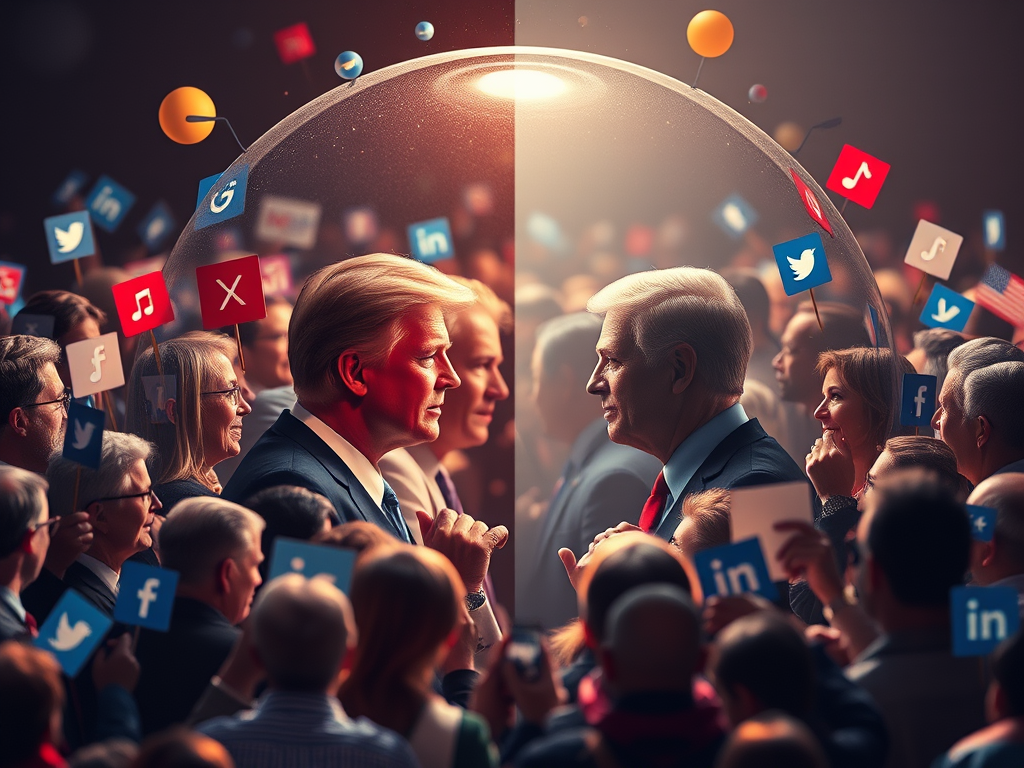
In 1972, Irving Janis labeled “groupthink” as a group’s drive for agreement overriding reason. In 2025, it’s no longer just a concept – it’s shaping American politics, stifling debate, and deepening divides. From X timelines to policy chambers, it’s here.
Social Media’s Echo Chambers
Platforms like X amplify bias through algorithms that feed users content matching their views, creating “filter bubbles” (Pariser, 2011). Pew’s 2025 findings show 65% of U.S. adults rely on social media for news, up 3% from 2023, with X a key player (Pew Research Center, 2025). An MIT study notes X users encounter 80% like-minded posts, reinforcing rather than challenging perspectives (MIT, 2024).
Polarization Deepens
The 2024 election widened an already stark divide. Gallup’s 2025 poll finds 79% of Americans see the nation as more fragmented than ever, up 2% from 2024 (Gallup, 2025). Groupthink drives this: dissenting voices fade, and it’s “us versus them” across platforms like X, where #MAGA2025 and #BlueWave2025 rarely overlap.
On April 2, 2025, President Trump declared “Liberation Day,” imposing 25% tariffs on Canada, Mexico, and China. Economists like Helen Schneider predict a 1.2% GDP decline and 15% price increases by Q3 (Schneider, Reuters, 2025). The U.S. Chamber of Commerce estimates 400,000 manufacturing job losses (USCC, 2025). Supporters view it as a stand for American strength; opponents foresee economic strain. Neither engages the other – echo chambers hold firm.
Yet groupthink can enable swift action. In urgent times, unity cuts through delays. Trump’s tariff move might pressure China into a 10% tariff reduction by year-end, per Bloomberg’s analysis (Bloomberg, 2025). A cohesive stance could yield leverage.
The Risk: Unchecked Consequences
Still, untested consensus invites trouble. The 2003 Iraq War – built on unchallenged WMD claims – cost $2 trillion and 4,500 lives (CBO, 2020). Today, tariffs could raise Southwest Virginia tech costs by 20%, threatening its economic shift (Virginia Tech Econ Report, 2025). Agreement without scrutiny often backfires.
Groupthink’s impact is clear:
- Flawed Decisions: Bay of Pigs, Iraq, perhaps tariffs next.
- Standoffs: X reflects a landscape where compromise erodes.
- Trust Loss: With 63% of Americans skeptical of Congress, groupthink widens the gap (AP-NORC, 2025).
Breaking the Pattern
Solutions exist:
- Value Dissent: X could reward well-reasoned counterpoints to spark debate.
- Build Skills: Virginia’s 2025 media literacy program cut misinformation shares 30% in schools (VA DOE, 2025) – expand it.
- Foster Dialogue: X “bridge threads” could host moderated cross-party talks.
In 2025, groupthink fuels social media bubbles, tariff debates, and a love-hate dance with unity. The way out: embrace dissent, sharpen reasoning, and prioritize discussion over division.
The 2025 Challenge
Groupthink defines this moment, but it’s not fixed. One voice, one vote, can shift the tide. With diverse perspectives, critical thought, and open exchange, we might reclaim a politics that listens. What breaks your echo chamber first – silence or a step forward?
References
- AP-NORC. (2025). Trust in Government Survey.
- Bloomberg. (2025). Trade War Scenarios 2025.
- CBO. (2020). Iraq War Cost Estimates.
- Gallup. (2025). State of the Nation Poll.
- Janis, I. L. (1972). Victims of Groupthink.
- MIT. (2024). Social Media Echo Chamber Study.
- Pariser, E. (2011). The Filter Bubble.
- Pew Research Center. (2025). News Use Across Platforms.
- Schneider, H. (2025). “Tariffs and the Fed.” Reuters.
- USCC. (2025). Tariff Impact Report.
- VA DOE. (2025). Media Literacy Pilot Results.
- Virginia Tech. (2025). Economic Forecast: Southwest VA.





Leave a Reply