
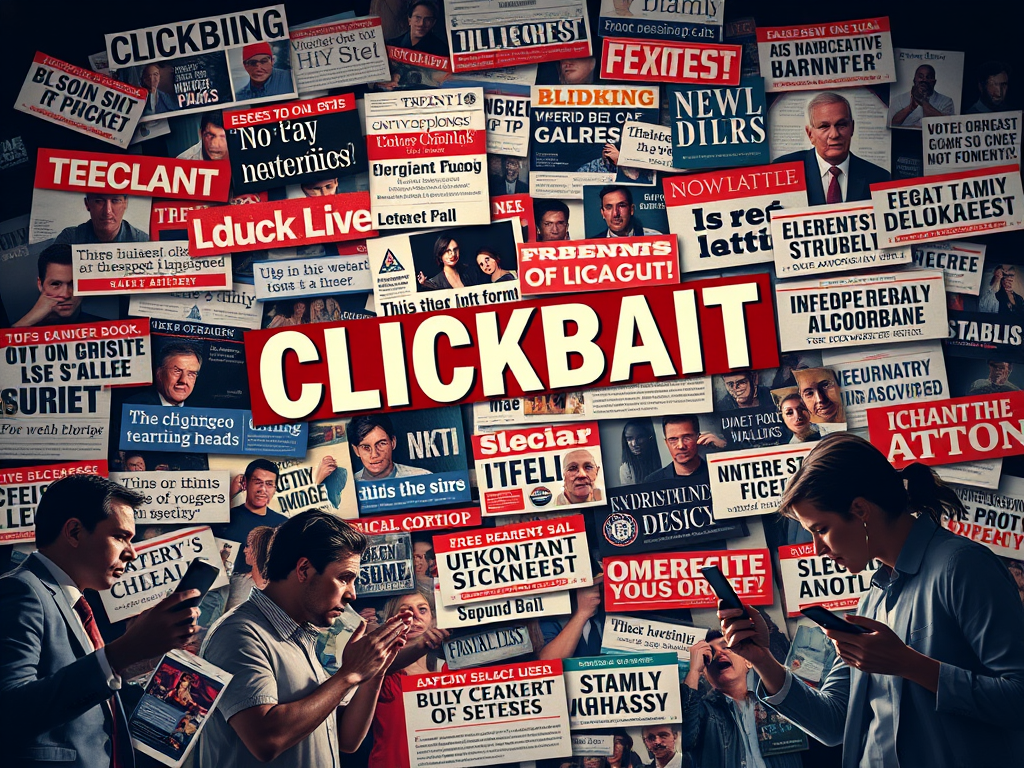
You’ve likely noticed how online spaces are flooded with eye-catching headlines – those “SHOCKING!” claims, the “Who’s to blame?” questions, the “You won’t believe what happened!” teases. They’re crafted to pull us in, often at the cost of deeper understanding. When we click, share, or debate in the comments, we can fuel a system that prioritizes division over solutions.
The people behind this – whether media outlets, influencers, or others—often know how to grab our attention. Headlines like “This One Law Could Ruin Everything!” or “Are They Hiding the Truth from You?” play on our instincts. Not all clickbait is harmful – some might lead to interesting or informative content – but too often, it pulls focus from meaningful questions: Who’s shaping the policies that affect us? What’s stalling progress on issues we care about? Those discussions get overshadowed by viral distractions and endless arguments.
Why Clickbait Works So Well
Clickbait taps into our psychology in ways that are hard to resist. It exploits what psychologists call the “curiosity gap” – a headline gives just enough to spark interest but leaves out key details, compelling us to click for closure. A 2014 study by George Loewenstein, a behavioral economist, described this as an “information gap” that drives human behavior (Loewenstein, 1994). Socially, it thrives in an attention economy where platforms reward engagement – likes, shares, clicks – over substance. Algorithms amplify divisive content because they keep us scrolling longer, as media scholar Danah Boyd noted: “The attention economy incentivizes spectacle, not dialogue” (Boyd, 2017).
It’s not just about individual psychology – societal factors play a role too. In polarized times, we’re drawn to narratives that confirm our biases, a phenomenon called confirmation bias. Clickbait leverages this by framing issues in black-and-white terms – “Us vs. Them” – which simplifies complex realities but deepens divides. According to Dr. Natalie Stroud, a communication researcher, “People are more likely to engage with content that aligns with their beliefs, especially when it’s emotionally charged” (Stroud, 2017).
Real-World Examples of Clickbait
To see this in action, consider these types of headlines you’ve probably come across:
- “The One Secret Politicians Don’t Want You to Know!” (Vague, teases a reveal with no substance upfront.)
- “You’ll Be Outraged When You See What Happened Next!” (Emotion-driven, lacks specifics.)
- “Is This the End of Free Speech as We Know It?” (Fear-mongering question with no clear answer.)
These examples aren’t tied to one agenda—they span topics from politics to health to entertainment. While some might link to decent articles, many lead to shallow content or ad-heavy pages, leaving us no better informed. Studies show this tactic works across the spectrum—research from NYU’s Center for Social Media and Politics found that emotionally charged headlines draw clicks regardless of political affiliation (NYU Study).
What’s the Impact?
When we get caught up in this cycle, we often lose sight of what matters. Not every catchy headline is a problem—some might point to valuable insights—but the broader pattern can distract us. Issues like healthcare reform, economic inequality, or infrastructure improvements don’t get the attention they deserve because they’re less “clickable” than the latest scandal or outrage. Meanwhile, those creating clickbait-heavy content—whether for ad revenue or influence—benefit from keeping us engaged, not informed. It’s a system that can leave us more divided and less focused on solutions.
How to Navigate the Noise with Media Literacy
We can take control by being more intentional about how we engage online. Here are practical steps to build media literacy and prioritize substance over distraction:
- Pause and Assess: If a headline seems overly sensational or emotionally charged, take a moment. Ask: Does this aim to inform or just provoke?
- Verify the Source: Check who’s behind the content. Look for an author’s name, publication history, or an “About” page to gauge credibility. If it’s unclear, search the outlet’s reputation.
- Seek Primary Sources: Go straight to raw data or original documents—check voting records on Congress.gov, read government reports on GovInfo.gov, or track funding on OpenSecrets.org.
- Explore Multiple Angles: Use tools like AllSides.com to see how different outlets frame the same story, or browse X for varied perspectives (but focus on reasoned voices, not just the loudest).
- Spot Red Flags: Clickbait often uses vague teases, exaggerated claims, or loaded language. If facts are thin or emotion is high, dig deeper. Fact-checking sites like Snopes or PolitiFact can help verify claims.
- Share Wisely: Before sharing, ensure the content adds value. If it’s more noise than substance, reconsider—or add context to steer the conversation toward clarity.
Let’s Refocus on What Counts
Our attention is worth more than a quick click on a flashy headline. Not every piece of clickbait is malicious, and not every creator is out to mislead—but we can all be more mindful about what we engage with. Take a beat the next time you see a post pushing for an instant reaction. Ask yourself: Is this helping me understand the world better, or just stirring the pot? We can push for more substance—from media, creators, and ourselves. What small step will YOU take to move past the noise and toward the truth?
#ThinkDeeper #CutTheNoise #MediaLiteracy




Leave a Reply